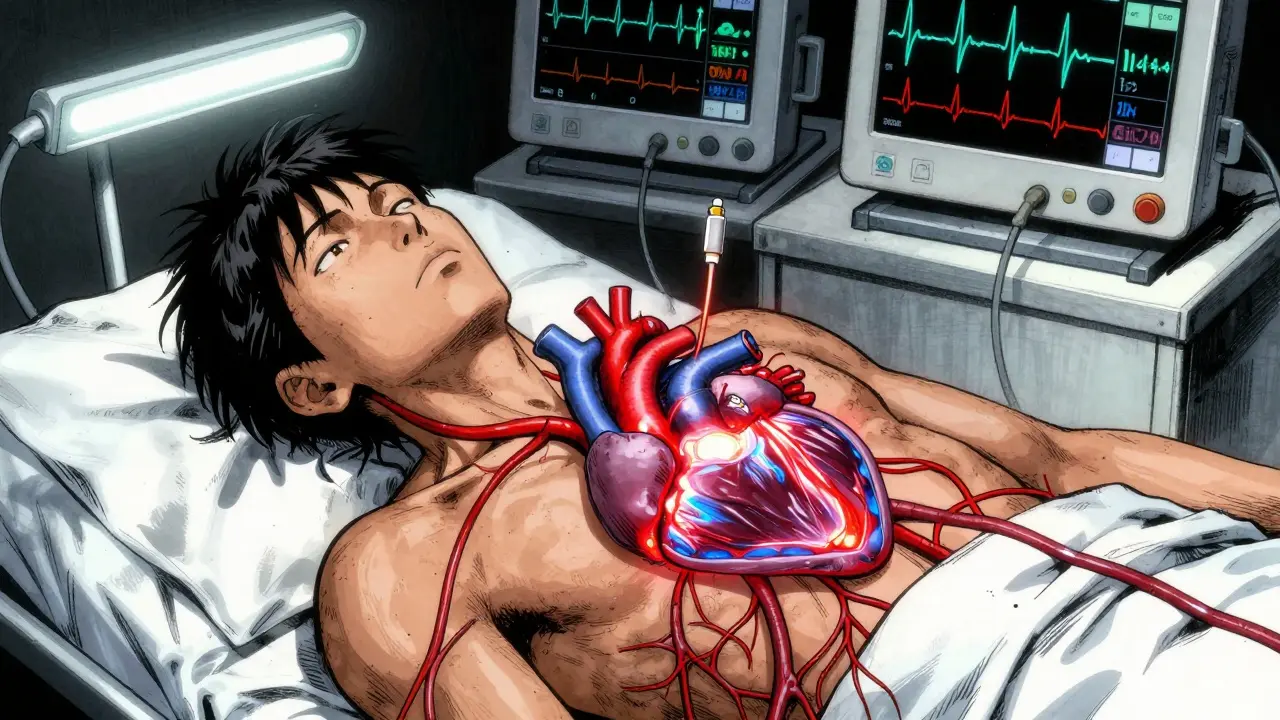
When your heart skips, races, or flutters without reason, it’s not just annoying-it can be dangerous. Arrhythmias, or irregular heartbeats, affect millions worldwide, and for many, pills alone aren’t enough. That’s where catheter ablation and device therapy come in. These aren’t experimental treatments. They’re proven, widely used, and often life-changing.
What Happens When Your Heart Gets Out of Sync?
Your heart beats because of electrical signals. When those signals go haywire, you get an arrhythmia. The most common type? Atrial fibrillation (AFib). It doesn’t just cause palpitations. It raises your risk of stroke, heart failure, and even death. For years, doctors reached for antiarrhythmic drugs first. But those meds often don’t work well long-term. They come with side effects-fatigue, dizziness, even worse heart rhythms. And they don’t fix the root problem. That’s why more people are turning to procedures that target the source: abnormal electrical pathways in the heart. Two main approaches exist: catheter ablation, which burns or freezes the trouble spots, and device therapy, which uses implanted gadgets to monitor and correct rhythm.Catheter Ablation: Zapping the Problem at Its Source
Catheter ablation is a minimally invasive procedure. You’re awake but sedated. A thin tube (catheter) is threaded through a vein in your groin or neck up to your heart. Once in place, the doctor delivers energy-either heat (radiofrequency) or cold (cryoablation)-to destroy the tiny areas of tissue causing the misfires. The most common target? The pulmonary veins. In over 90% of AFib cases, the abnormal signals start there. The goal is to create a ring of scar tissue around these veins-called pulmonary vein isolation-to block the erratic signals from spreading. Modern ablation tools are smarter than ever. The THERMOCOOL SMARTTOUCH catheter, made by Biosense Webster, measures how hard it’s pressing against heart tissue. Too little pressure? The burn won’t stick. Too much? You risk damaging the heart wall. This device calculates an “Ablation Index” in real time-factoring in pressure, time, and power-to ensure each spot gets just the right dose. Studies show this cuts recurrence rates by 12-15% compared to older catheters. Cryoablation, like Medtronic’s Arctic Front Advance, uses freezing instead of burning. It’s faster-often under two hours-and works well for patients with simpler AFib. But it carries a small risk of injuring the phrenic nerve, which controls your diaphragm. That’s why doctors monitor breathing during the procedure.How Effective Is It?
The numbers speak for themselves. In a 2020 review of 1,797 patients, ablation reduced AFib recurrence by 58% compared to medication. For people with heart failure and AFib, the benefits are even clearer. One study showed ablation improved heart pumping strength by over 5%, increased walking distance by 25 meters, and cut mortality risk by nearly half. It’s not just about survival. It’s about quality of life. Patients report less anxiety, better sleep, and the freedom to return to activities they love. One man in Sydney, 58, got his cryoablation in March 2022. He’s been AFib-free since. He’s back on his bike, racing weekend club events. Another patient on Reddit said, “I went from daily palpitations to zero episodes in nine months. The mental relief? That’s worth everything.”
Device Therapy: Pacemakers and ICDs for When Ablation Isn’t Enough
Not all arrhythmias are caused by stray electrical sparks. Some hearts are too slow. Others beat too fast and dangerously. That’s where devices come in. Pacemakers are tiny batteries implanted under the skin. They send electrical pulses to keep your heart from beating too slowly. They’re standard for bradycardia, especially after ablation if the heart’s natural rhythm gets too weak. For those at risk of sudden cardiac arrest-often due to ventricular tachycardia or fibrillation-an implantable cardioverter-defibrillator (ICD) is life-saving. It constantly monitors your heart. If it detects a deadly rhythm, it delivers a shock to reset it. Think of it as an internal defibrillator. It doesn’t prevent arrhythmias, but it stops them before they kill. Some newer devices combine both functions. They can pace your heart, detect fast rhythms, and zap them if needed. These are often used in patients with both AFib and heart failure.Ablation vs. Devices: When Do You Choose What?
It’s not an either-or. Often, they’re used together. If you have paroxysmal AFib-episodes that start and stop on their own-and drugs failed, ablation is the next step. The European Society of Cardiology gives it a top recommendation for this group. If you have persistent AFib (episodes lasting days or weeks) or heart failure, ablation still helps, but the success rate drops a bit. That’s where device therapy often joins in. An ICD might be implanted if your heart’s pumping is weak. A pacemaker might be added if ablation slows your heart too much. For slow heart rhythms caused by aging or medication side effects? Skip ablation. Go straight to a pacemaker.What Are the Risks?
No procedure is risk-free. Major complications happen in about 8% of ablations. The most serious? Cardiac tamponade-blood leaking into the sac around the heart. It’s rare (1.2% chance) but needs immediate drainage. Other risks include blood clots, stroke, damage to blood vessels, or injury to the esophagus (especially with radiofrequency). Cryoablation has a higher chance of phrenic nerve injury. Most are treatable if caught early. Recovery is usually quick. Most people go home the same day or next morning. You’ll need to avoid heavy lifting for a week. Some feel chest discomfort or skipped beats for a few weeks as the heart heals. That’s normal.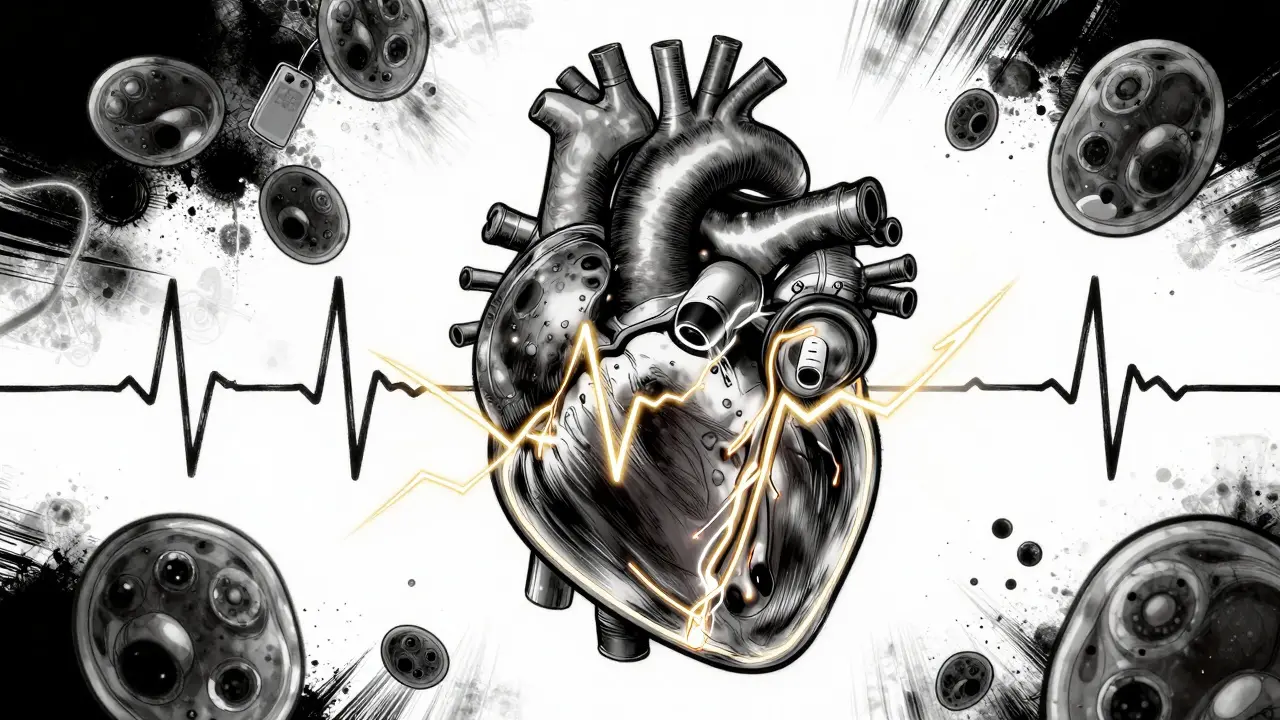
Cost and Access: Is It Worth It?
Ablation costs between $16,000 and $21,000 upfront. That’s more than a year’s worth of pills. But here’s the twist: after 3 to 8 years, it pays for itself. Why? Fewer hospital visits. Less medication. Lower risk of stroke and heart failure. Reimbursement in the U.S. averages $18,500. In Europe, it’s €12,000-15,000. The problem? Access. Rural areas have 60% fewer centers that do these procedures than cities. If you’re not near a major hospital with an electrophysiology lab, getting treatment can be a long journey.What’s Next? The Future of Heart Rhythm Treatment
The biggest breakthrough on the horizon? Pulsed field ablation (PFA). It uses electric pulses instead of heat or cold. It’s faster-under 80 minutes-and safer. In early trials, no patients had esophageal burns, a common issue with radiofrequency. The Farapulse system got FDA approval in September 2023. Early results show 86% freedom from AFib at one year. AI is also stepping in. Software like Medtronic’s AI Path, launching in 2025, will analyze heart maps in real time and suggest where to ablate. It could make procedures faster and more accurate. By 2030, experts predict ablation will become first-line treatment for most symptomatic AFib patients-not just after drugs fail. That’s how confident the data has become.What Should You Do If You Have an Arrhythmia?
If you’re on meds and still feel your heart racing or skipping, talk to your cardiologist. Ask: “Could ablation help me?” Don’t wait until you’ve tried three drugs and had three ER visits. If you have heart failure and AFib, the evidence is especially strong. Ablation isn’t just about rhythm-it’s about survival. And if you’re told you need a pacemaker or ICD? Understand why. Ask if ablation could reduce your need for it later. This isn’t about choosing between drugs and surgery. It’s about choosing the right tool for your body. For many, catheter ablation isn’t a last resort. It’s the best first step toward a steady, strong heartbeat.Is catheter ablation a cure for atrial fibrillation?
It’s not always a permanent cure, but it’s the most effective way to control AFib long-term. About 70-80% of people with paroxysmal AFib stay free of episodes after one procedure. For persistent AFib, success rates are lower-around 60-70%. Many need a second session. Even then, most reduce or stop antiarrhythmic drugs and report better quality of life.
How long does it take to recover from catheter ablation?
Most people go home the same day or the next morning. You’ll feel soreness in the groin or neck where the catheter went in. Avoid heavy lifting or strenuous activity for 5-7 days. Some feel extra heartbeats or mild chest discomfort for up to 4 weeks-that’s normal as the heart heals. Full recovery usually takes 2-4 weeks.
Can you have both ablation and a pacemaker?
Yes, and it’s common. Ablation can sometimes slow the heart too much, especially in older patients. If that happens, a pacemaker is implanted to keep the rhythm steady. Many people with heart failure and AFib get both-a pacemaker to regulate slow beats and an ICD to stop dangerous fast ones. The devices work together.
What’s the difference between radiofrequency and cryoablation?
Radiofrequency uses heat (like a tiny burn) to destroy tissue. Cryoablation uses extreme cold to freeze it. Radiofrequency allows more precise targeting and is better for complex cases. Cryoablation is faster and simpler, often used for standard AFib. Cryo has a slightly higher risk of injuring the phrenic nerve. Success rates are similar, but radiofrequency with contact force sensing has better long-term results.
Are there alternatives to ablation and devices?
Medications are the only alternative, but they’re often less effective and come with side effects. Some people try lifestyle changes-cutting caffeine, losing weight, managing stress-but these help mostly with mild cases. For moderate to severe arrhythmias, ablation and devices are the only proven ways to restore normal rhythm long-term.
Who is not a good candidate for catheter ablation?
People with very advanced heart disease, large blood clots in the heart, or those who can’t take blood thinners are higher risk. Those with extremely enlarged hearts or long-standing persistent AFib may have lower success rates. Age alone isn’t a barrier-many people in their 80s do well. The key is overall health, not just age.



Robyn Hays
December 29, 2025 at 10:28
I had my first ablation last year and honestly? My life changed. I used to wake up three times a night feeling like my heart was trying to escape my chest. Now? I sleep like a baby. No more anxiety attacks before workouts. No more avoiding stairs. The recovery was weird - felt like I’d been punched in the chest for a week - but totally worth it. I even started hiking again. Who knew a tiny wire could fix so much?
Also, the catheter with the pressure sensor? Total game changer. My doc said without it, I’d probably be back on meds with zero results. Now I’m off everything. Mind blown.