Malignant Hyperthermia Risk Assessment Calculator
This calculator helps you understand your risk for malignant hyperthermia (MH), a rare but serious reaction to certain anesthetic drugs. Enter your information to get personalized risk assessment.
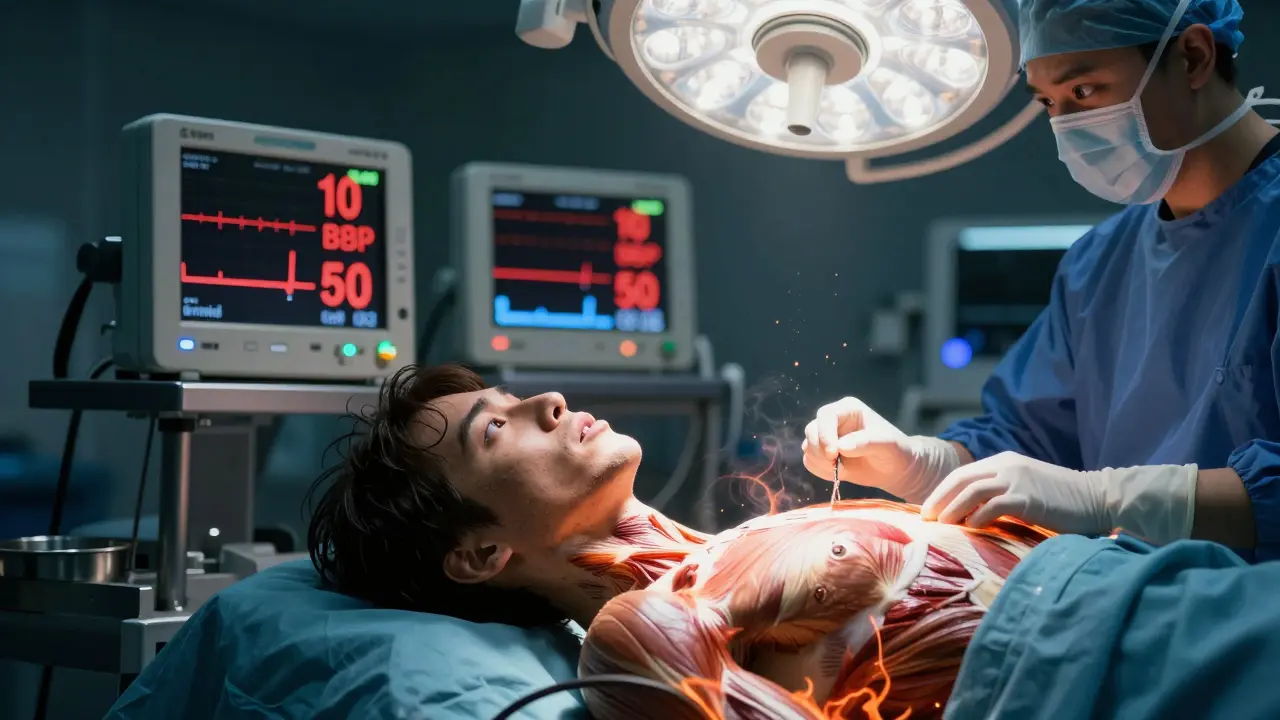
When you walk into a hospital for surgery, you expect to be safe. You trust the team to monitor your body, manage pain, and keep you stable. But for a tiny fraction of people-about 1 in 5,000 to 1 in 100,000-a routine anesthetic can trigger something terrifying: malignant hyperthermia. It doesn’t come with warning signs. No prior illness. No family history. Just a single breath of anesthetic gas, and your muscles lock up, your body overheats, and your organs start to shut down. This isn’t a myth. It’s real. And if you don’t act fast, it can kill you.
What Exactly Is Malignant Hyperthermia?
Malignant hyperthermia (MH) is a genetic disorder that turns your muscles into a furnace. It’s not an allergy. It’s not an infection. It’s a glitch in your muscle cells. When someone with MH is exposed to certain anesthetics, calcium floods out of storage in their muscle cells. That calcium tells muscles to contract-and they don’t stop. Your body burns through oxygen, produces massive amounts of heat, and starts breaking down muscle tissue. The result? A body temperature that can spike above 109°F (43°C), a heart racing at 180 beats per minute, and blood chemistry that turns toxic.
This reaction is triggered by two types of drugs: volatile anesthetic gases like sevoflurane, desflurane, and isoflurane, and the muscle relaxant succinylcholine. These are common in surgeries-from tonsillectomies in kids to knee replacements in adults. The problem? You won’t know you’re at risk until it happens. About 29% of MH cases occur in people with no family history of the condition. That means even if your parents and grandparents never had a problem under anesthesia, you could still be carrying the gene.
The First Signs: Don’t Wait for the Fever
Many people think MH starts with a high fever. It doesn’t. The earliest warning signs are subtle, and they happen within minutes of the anesthetic being given. The first red flag? A sudden, unexplained rise in heart rate. In adults, that’s over 120 beats per minute. In kids, it’s even faster. Next, your breathing rate spikes. Your body is trying to get rid of excess carbon dioxide, which builds up because your muscles are working nonstop. You’ll see this on the monitor as a spike in end-tidal CO2-above 55 mmHg.
Then comes muscle rigidity. Not all over your body, but often in the jaw. That’s called masseter muscle rigidity. If a surgeon notices the patient’s jaw is locked shut after giving succinylcholine, that’s a major red flag. It’s not normal. It’s the first sign of MH in about 40% of cases.
After that, the temperature starts climbing. It can go from normal to over 104°F (40°C) in under 30 minutes. Blood tests show acidosis, high potassium, and skyrocketing creatine kinase (CK) levels-sometimes over 10,000 U/L. Your urine turns dark, like cola or blood. That’s myoglobin from destroyed muscle tissue. If this isn’t stopped, you’ll go into cardiac arrest.
How It’s Treated: Dantrolene Is the Only Answer
There’s one drug that stops malignant hyperthermia. One. And it’s not new-it’s been around since the 1970s. It’s called dantrolene. It works by blocking calcium release in muscle cells. No calcium, no uncontrolled contractions. No contractions, no overheating.
But timing is everything. If dantrolene is given within 20 minutes of the first symptoms, survival rates are close to 100%. If you wait 40 minutes, mortality jumps to 50%. That’s why every operating room that uses general anesthesia must have dantrolene ready-immediately.
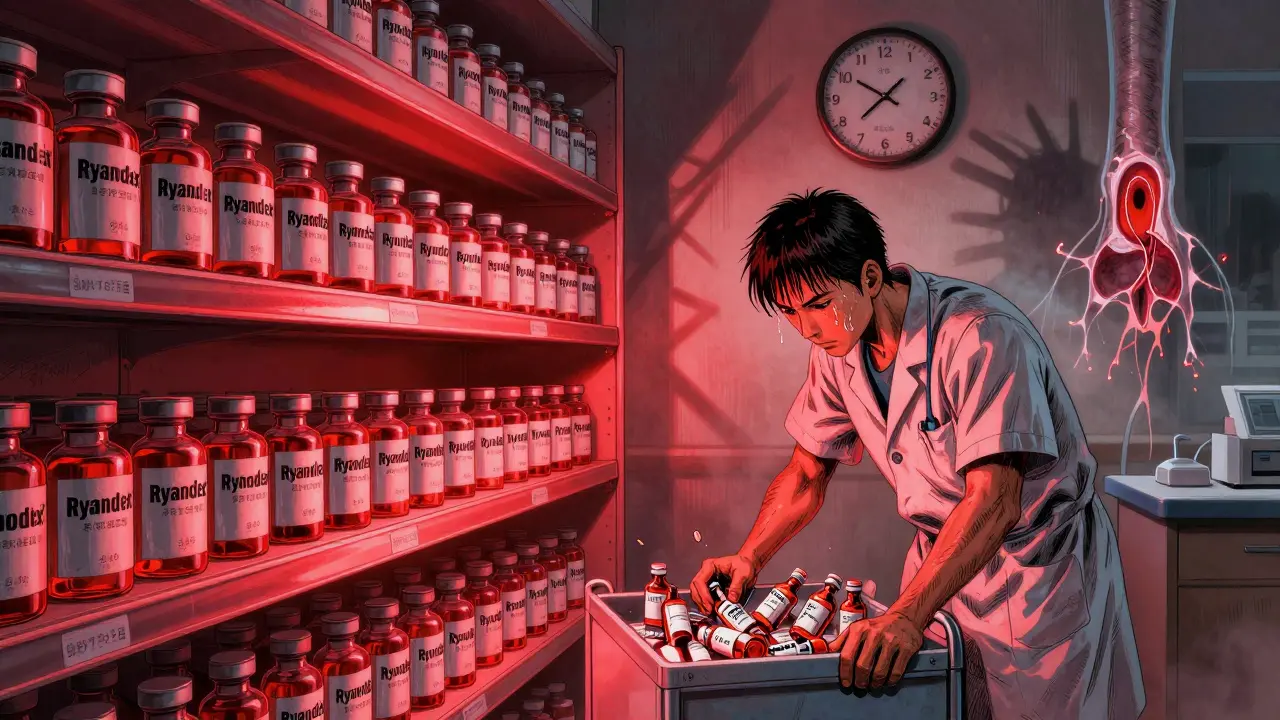
There are two forms: Dantrium® and Ryanodex®. Dantrium® takes 22 minutes to mix. Ryanodex®, approved in 2014, mixes in 1 minute. That’s why Ryanodex® is now the standard. Each vial costs about $4,000. A full adult dose needs 10-20 vials. That’s $40,000 to $80,000 in one shot. Hospitals are required to keep at least 36 vials on hand. That’s $144,000 just in stock.
But dantrolene isn’t the only thing needed. The team must:
- Stop all triggering anesthetics immediately
- Switch to 100% oxygen at 10 liters per minute
- Hyperventilate to flush out CO2
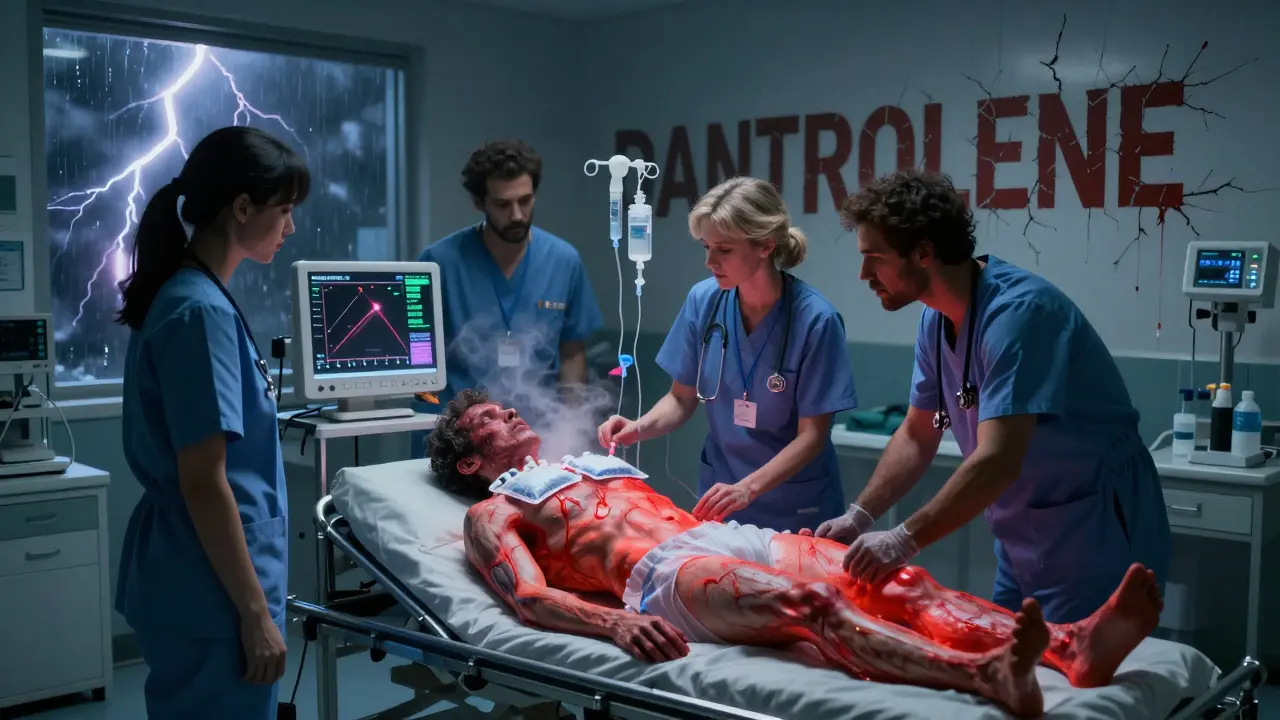
- Start cooling-ice packs on neck, armpits, groin
- Give IV fluids with sodium bicarbonate to fix acidosis
- Use insulin and glucose to lower dangerous potassium levels
- Give mannitol and furosemide to protect the kidneys from muscle breakdown
Every second counts. In 2023, Mayo Clinic reported that after installing dedicated MH carts with pre-mixed dantrolene, they cut treatment time from 22 minutes to under 5 minutes. Survival rates jumped.
Who’s at Risk? It’s Not Just Family History
For years, doctors thought MH ran in families. And yes, about 70% of cases are linked to mutations in the RYR1 gene on chromosome 19. Another 1% involve CACNA1S. But here’s the twist: nearly a third of MH cases happen in people with no known family history. That means routine screening based on relatives won’t catch everyone.
Genetic testing for RYR1 is available. It costs between $1,200 and $2,500 and has 95% accuracy for known mutations. But it’s not perfect. Not all mutations are known. And not everyone with the gene has a reaction. So testing is recommended for people with a family history, unexplained deaths in relatives during anesthesia, or those who’ve had muscle rigidity during surgery.
Children are at higher risk. Tonsillectomies in kids under 10 have an incidence of 1 in 3,000. That’s why many pediatric centers now avoid succinylcholine unless absolutely necessary. They also use non-triggering anesthetics like propofol and remifentanil when possible.
Why Hospitals Fail: The Real Problem Isn’t the Drug, It’s the System
The science is clear. The treatment is proven. So why do people still die?
Because not every hospital is prepared. A 2022 survey found that only 63% of rural surgical centers in the U.S. kept the required dantrolene stock. Many didn’t have trained staff. Some didn’t even have a written emergency protocol. One anesthesiologist on Reddit described a case where the team didn’t recognize masseter rigidity. They thought it was just “tight jaw.” By the time they gave dantrolene, it was too late.
The Malignant Hyperthermia Association of the United States (MHAUS) runs a 24/7 hotline (1-800-644-9737). They’ve helped save hundreds of lives by guiding teams through the crisis. But you can’t call a hotline if you don’t know what you’re seeing.
Training matters. Anesthesiology residents need at least three simulation drills to reliably spot MH. Yet many hospitals skip drills because they’re expensive or “not necessary.” The American Society of Anesthesiologists made annual MH drills mandatory in 2018. Compliance is still patchy.
What’s Next? The Future of MH Prevention
There’s hope on the horizon. In 2023, the FDA approved a new intranasal form of dantrolene for emergency use outside the hospital-expected to hit the market in mid-2024. That means paramedics could give it in the field before the patient even reaches the OR.
Researchers are also testing drugs like S107, which stabilize the ryanodine receptor and prevent calcium leaks. If they work, they could be used preventively in high-risk patients.
And then there’s gene editing. CRISPR-based therapies to fix RYR1 mutations are in early development. Phase I trials are expected by 2027. That’s not a cure yet-but it’s a path toward one.
For now, the best defense is awareness. If you’ve had unexplained muscle stiffness during anesthesia, or if someone in your family died unexpectedly during surgery, ask for genetic testing. Tell your anesthesiologist. Ask if the hospital has dantrolene on hand. Ask if they’ve done an MH drill this year.
Because in the end, malignant hyperthermia isn’t about bad luck. It’s about preparedness. And if you’re ever in an operating room, you want the team to be ready.
Can malignant hyperthermia be prevented?
Yes, if you know you’re at risk. Genetic testing for RYR1 and CACNA1S mutations can identify susceptibility. If you test positive, your anesthesiologist can avoid triggering drugs like sevoflurane and succinylcholine. Instead, they’ll use safer alternatives like propofol, ketamine, or regional anesthesia. For those without known risk, hospitals must maintain emergency dantrolene stock and staff training to respond if a reaction occurs.
Is malignant hyperthermia inherited?
Yes, in most cases. About 70% of people with MH have a mutation in the RYR1 gene, which is passed down from parent to child in an autosomal dominant pattern. That means if one parent has the gene, each child has a 50% chance of inheriting it. But not everyone with the gene has a reaction. Environmental triggers like anesthesia are needed to set off the crisis. About 29% of cases occur in people with no family history, suggesting new mutations or undiagnosed carriers.
Can you survive malignant hyperthermia without dantrolene?
Survival without dantrolene is extremely rare. Before dantrolene was introduced in the 1970s, MH was fatal in 80% of cases. Even today, if dantrolene is delayed or unavailable, mortality rises sharply. Cooling, oxygen, and fluid support help-but they don’t stop the calcium flood in muscle cells. Only dantrolene directly targets the root cause. Without it, the body’s metabolism runs out of control, leading to organ failure and death.
How long does it take for malignant hyperthermia to develop?
Symptoms usually appear within 30 minutes of exposure to triggering agents, often within the first 10 minutes. Most cases show signs within one hour. However, rare cases have developed up to 24 hours after surgery, especially if the trigger was given during induction and the reaction was slow to build. This is why monitoring continues even after anesthesia ends.
Do all anesthetics cause malignant hyperthermia?
No. Only specific agents trigger MH: volatile inhalational anesthetics (sevoflurane, desflurane, isoflurane, halothane) and the muscle relaxant succinylcholine. Many common anesthetics are safe, including propofol, ketamine, etomidate, lidocaine, and regional techniques like spinal or epidural blocks. Patients with known MH risk can safely undergo surgery using these alternatives.
Can you get tested for malignant hyperthermia before surgery?
Yes. Genetic testing for RYR1 and CACNA1S mutations is available through certified labs and costs $1,200-$2,500. It’s most useful if you have a family history of MH, unexplained anesthesia-related deaths, or a personal history of muscle rigidity during surgery. A more definitive test is the in vitro contracture test (IVCT), which involves taking a muscle biopsy and exposing it to triggering agents. It’s highly accurate but invasive and only done in specialized centers. Most people rely on genetic testing and family history for screening.






Ritteka Goyal
February 7, 2026 at 18:25
OMG this is so important!! I had my tonsillectomy at 7 in India and my mom said the docs just gave me the gas like nothing, no questions asked. Now I’m terrified. Why don’t they test kids here? We pay for fancy hospitals but they don’t even have dantrolene on hand in 80% of places. My cousin’s brother died during a simple dental procedure 10 years ago and they called it ‘complications’-no one ever said MH. We need mandatory screening in schools, like vaccines. This isn’t just medical-it’s a human rights issue. Why are we letting corporations decide who lives or dies because of cost? I’m crying rn.