It’s 2026. You walk into the pharmacy to refill your blood pressure medication. The pharmacist hands you a small white pill in a plain bottle. "This is the generic," they say. "Same active ingredient. Just cheaper." You take it home, pop it, and… nothing. Or at least, that’s how it feels. Your headache doesn’t go away as fast. Your chest feels tighter. You wonder: Is this really the same drug?
Here’s the truth: it is. But your brain doesn’t believe it.
Why a $2 pill feels like it doesn’t work
Let’s be honest - we’ve all done it. We’ve looked at a generic drug and thought, "This can’t be as good as the name brand." Even if we know better. Even if we’ve read the studies. There’s a quiet, stubborn voice inside that says: Price equals power.
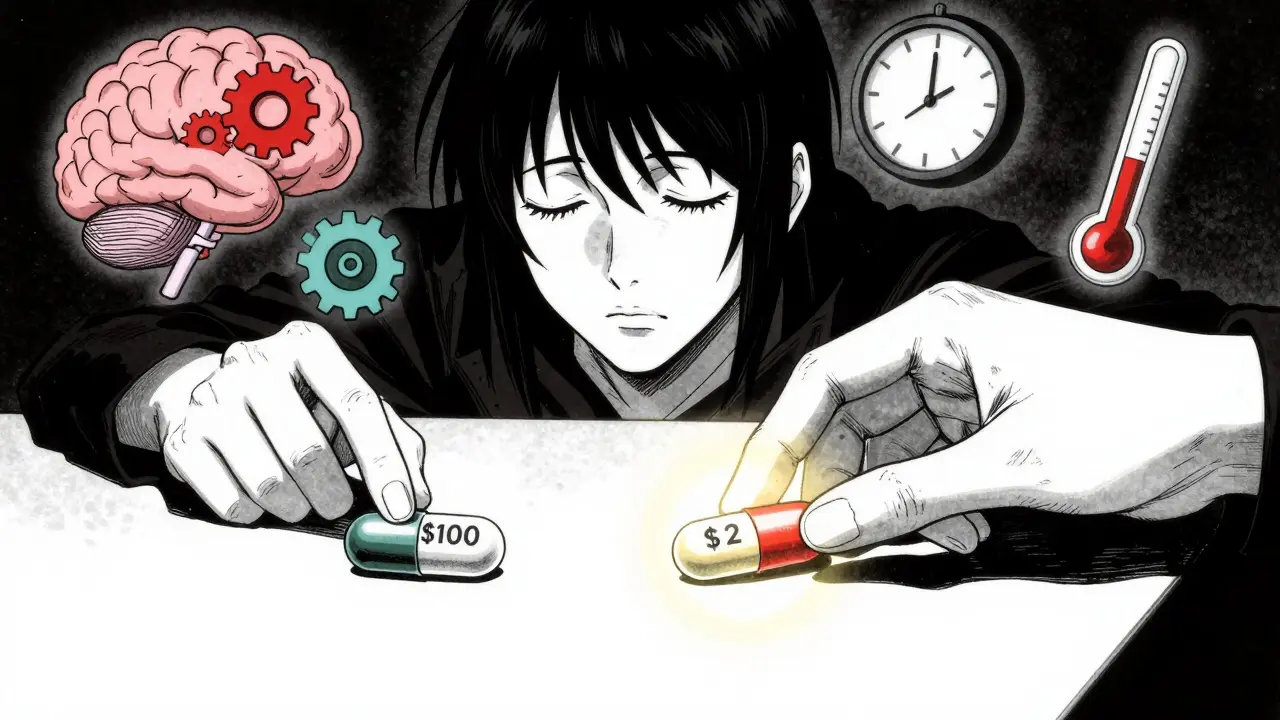
That’s not just superstition. It’s science. A 2023 study with 60 volunteers showed something startling. Everyone was given a placebo pill. Half were told it cost $100. The other half were told it cost $2. Both groups had the exact same chemical composition. But those who believed they were taking the expensive pill reported significantly higher effectiveness. Not because it worked better. Because they felt it worked better.
This isn’t about the drug. It’s about your brain.
The price-quality heuristic in action
Your brain doesn’t analyze drug labels like a chemist. It uses shortcuts. One of the oldest and most powerful? The price-quality heuristic. If something costs more, your brain assumes it’s better. It’s a survival trick. In nature, expensive things - rare fruits, powerful animals - usually mean higher value. Your brain hasn’t caught up to the fact that in modern medicine, the same molecule can be made for pennies.
And it gets worse. When you take a cheaper pill, your brain doesn’t just doubt its strength - it starts reinterpreting your body’s signals. In the same 2023 study, people who thought they were taking the expensive drug overestimated how many doses they’d taken. They remembered taking it more often. That memory, even if false, made them believe the drug was working better. Your mind is rewriting your experience to match your expectations.
What the pill looks like matters too
Ever notice how brand-name pills are often shiny, colorful, and smooth? Generics? Usually plain white or beige. Sometimes they taste bitter. Sometimes they’re harder to swallow.
That’s not random. Drug companies spend millions designing pills that feel like medicine. A glossy coating. A distinctive shape. A clean, crisp smell. These cues tell your brain: This is serious. This is powerful.
Generics? They’re made to be functional. Not fancy. And that’s where perception breaks down. A patient in a 2012 CDC focus group said it plainly: "Generic medicine is less potent… other medicine is stronger." Another: "Name brand is more powerful than the generic." They weren’t lying. They were feeling something real - even if the chemistry was identical.
Real people, real beliefs
It’s not just anecdotal. A national survey found that 25% of Americans believe generics are less effective. Another 20% think they’re less safe. Nearly one in three are unsure. And here’s the kicker: 46% are worried about side effects from generics. Even though the FDA requires generics to match brand-name drugs in absorption, strength, and purity.
That’s not ignorance. It’s psychology. And it’s costly.
When perception kills adherence
Imagine you’re managing diabetes. Your doctor switches you to a generic metformin to save money. You take it. But because you don’t believe it works, you start checking your blood sugar more often. You eat less. You exercise more. You feel more anxious. Your numbers don’t improve - not because the drug failed, but because your belief changed your behavior.
That’s the hidden cost of price-based perception. People stop taking their meds. They switch back to expensive brands. They skip doses. A 2012 study in Houston found that patients who believed generics were just as effective were three times more likely to use discount programs. The rest? They paid more. Or went without.
Doctors are the missing link
Here’s what research shows: It’s not the price that changes outcomes - it’s the conversation.
When a doctor says, "This generic is exactly the same as the brand. I’ve prescribed it for years. It works just as well," patients are far more likely to trust it. Not because they suddenly understand bioequivalence. But because someone they trust told them it was safe.
One study found that communication from healthcare providers was the strongest predictor of generic use - more than cost, more than education, more than personal beliefs. Patients don’t need a chemistry lesson. They need reassurance from someone they trust.

Why education doesn’t always work
Here’s the twist: Teaching people about generics doesn’t always fix the problem.
A University of Auckland study gave people a short lesson on how generics work. Afterward, they understood the science better. They said they’d prefer generics for serious illness. But when they actually took the pills - branded and generic - their reported pain relief didn’t improve. Even after learning the truth, their brains still responded to the price cue.
That’s because belief isn’t just about knowledge. It’s about emotion. It’s about sensory experience. It’s about trust.
What does this mean for you?
You’re not broken. You’re human.
If you’ve ever doubted a cheaper pill - you’re not alone. Your brain is doing what it’s been wired to do for thousands of years: use price as a shortcut to safety and effectiveness.
But here’s what you can do:
- Ask your doctor: "Is this generic the same as the brand? Have you used it yourself?"
- Don’t judge a pill by its color or taste. The active ingredient doesn’t care what it looks like.
- If you feel worse after switching, track your symptoms for a week. Sometimes it’s not the drug - it’s the anxiety around it.
- Remember: 90% of all prescriptions in the U.S. are generics. Billions of doses are taken every year. If they didn’t work, we’d know.
The bottom line
Generic drugs aren’t "weaker." They’re not "second-rate." They’re identical in active ingredients, strength, and safety. The FDA doesn’t approve them unless they match the brand within 80-125% of its effect. That’s not luck. That’s science.
What’s different? Your expectation.
And that’s the real drug. Not the one in the bottle. The one in your head.
Next time you pick up a cheaper pill, pause. Ask yourself: Am I feeling this because the medicine changed… or because I thought it would?






Lorna Brown
March 13, 2026 at 11:10
This is so true. I never thought about how much our brains trick us into thinking price = quality. I switched to generics for my cholesterol meds and felt like they weren't working. Turns out I was just anxious. Took me a week to realize my body didn't change-my expectations did. 🤯