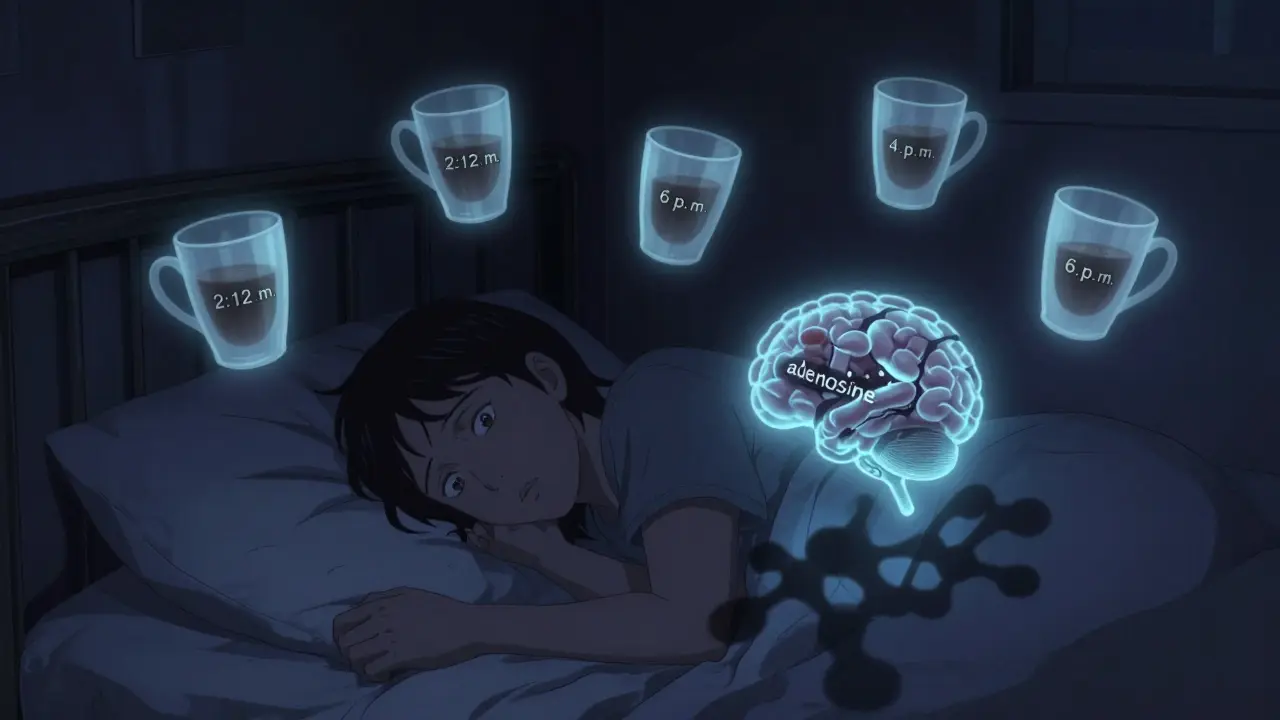
Most people know they shouldn’t drink coffee right before bed. But how late is too late? If you’re lying awake at 11 p.m. wondering why you can’t fall asleep-even though you had your last cup at 6 p.m.-you’re not alone. The truth is, caffeine doesn’t vanish when you finish your drink. It lingers. And for many, that lingering effect is quietly stealing hours of deep, restorative sleep.
Why Caffeine Keeps You Awake (Even If You Don’t Feel It)
Caffeine doesn’t work by making you jittery. It works by sneaking into your brain and blocking a chemical called adenosine. Adenosine builds up the longer you’re awake. It’s what makes you feel tired. When caffeine attaches to the same receptors adenosine normally uses, it stops the signal. Your brain doesn’t get the message to slow down. So even if you feel fine after your afternoon latte, your brain is still fighting off sleep signals.
That’s why you might fall asleep after coffee-but sleep poorly. Studies show caffeine reduces total sleep time by 45 minutes, cuts sleep efficiency by 7%, and adds 9 minutes to how long it takes you to fall asleep. You might think you’re sleeping fine. But your body knows the difference.
The 8-Hour Rule: It’s Not a Guess, It’s Science
For decades, people were told to avoid caffeine after 2 p.m. or 6 p.m. But those rules were too broad. They didn’t account for how much caffeine you’re actually consuming.
A 2021 review of 24 studies found that a standard 8-ounce cup of coffee (about 107 mg of caffeine) requires an 8.8-hour cutoff before bedtime to avoid disrupting sleep. That means if you go to bed at 11 p.m., you should stop drinking coffee by 2:12 p.m.
Why so long? Because caffeine’s half-life-the time it takes for half of it to leave your system-is 4 to 6 hours for most people. But that’s just half. The other half is still active. And by the time 8 hours pass, only about 12% of the original caffeine remains. That’s the level most studies show doesn’t interfere with sleep onset.
Compare that to the old 6-hour rule. That only clears about 25% of the caffeine. The rest? Still blocking your brain’s sleep signals.
Not All Caffeine Is the Same
One cup of coffee isn’t the same as one energy drink. Or one pre-workout scoop. Or one tablet of Excedrin.
- A standard 8-oz coffee: 107 mg caffeine → 8.8-hour cutoff
- Espresso shot (1 oz): 63 mg caffeine → ~5.2-hour cutoff
- Red Bull (8.4 oz): 80 mg caffeine → ~7.5-hour cutoff
- Pre-workout supplement: 200-300 mg caffeine → 12-15 hour cutoff
- Black tea: 20-48 mg caffeine → no clear cutoff needed for most
Pre-workout supplements are especially dangerous. Many people take them at lunchtime, thinking they’re just for energy. But with 217.5 mg or more per serving, that’s a 13.2-hour window before bedtime. That means if you take one at noon and sleep at 11 p.m., you’re still half-asleep from caffeine.
And don’t forget hidden sources. Chocolate, some medications, and even decaf coffee (yes, it still has caffeine) add up. One 2023 Sleep Foundation survey found 68% of people significantly underestimate caffeine in these sources.
Age and Genetics Change Everything
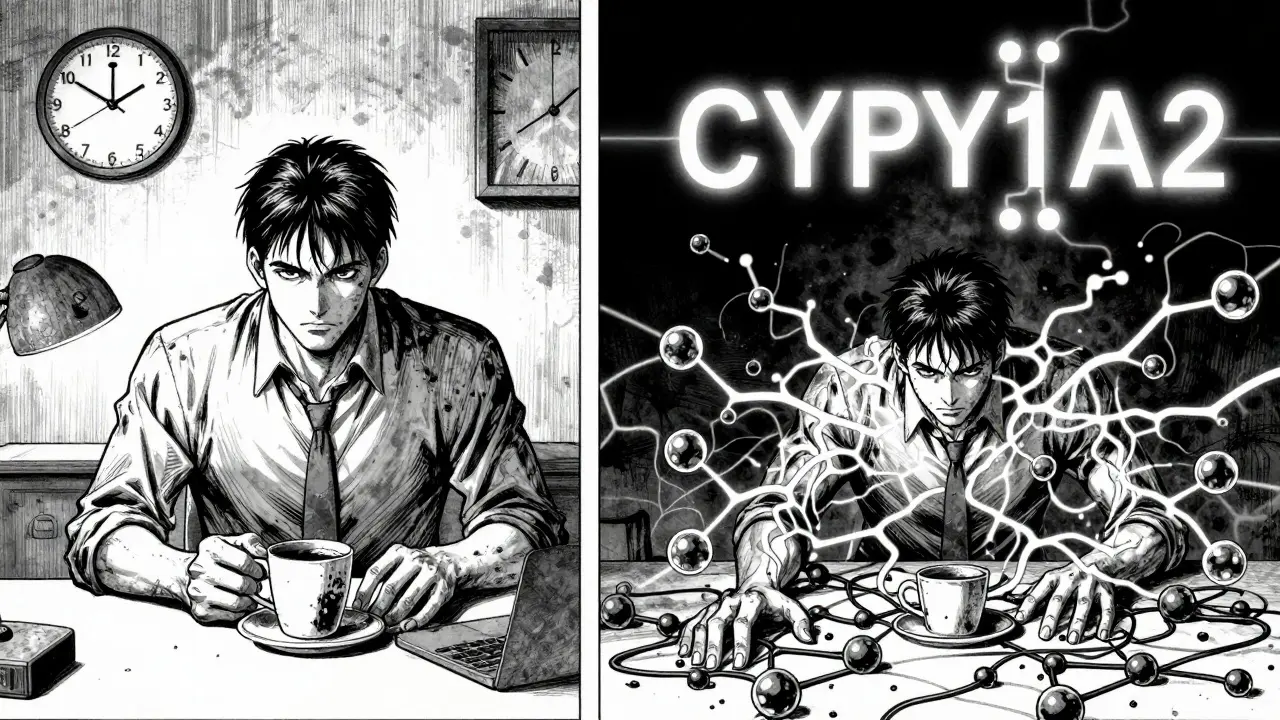
Not everyone metabolizes caffeine the same way. A gene called CYP1A2 controls how fast your liver breaks down caffeine. About 50% of people have a version that processes it slowly. For them, caffeine’s half-life can stretch to 12 hours.
That means if you’re a slow metabolizer, even a morning cup could be keeping you up at night. You might not feel it. But your sleep data will show it: less deep sleep, more awakenings, lower efficiency.
Age matters too. A 2025 study in Nature Communications found that adults between 41 and 58 are more sensitive to caffeine’s sleep-disrupting effects than younger adults. Their brains show stronger changes in brain activity during sleep after caffeine intake. So if you’re in your 40s or 50s and suddenly can’t sleep like you used to, caffeine might be the culprit-even if you haven’t changed your habits.
Real People, Real Results
Reddit users in r/sleep reported that 78% of those who drank coffee within 6 hours of bedtime struggled to fall asleep. Even more telling: 63% said their sleep quality suffered even when they did fall asleep.
One user, u/CaffeineStruggles, wrote: “I switched from my last coffee at 4 p.m. to 2 p.m. and gained almost an hour of sleep quality. Eye-opening.”
A 2022 survey of 2,150 people by Sleepopolis found that those who stopped caffeine by 2 p.m. got 47 more minutes of sleep and had 8% higher sleep efficiency than those who drank until 4 p.m.
And it’s not just anecdotal. A 2022 analysis of 15,328 sleep logs from the Sleep Cycle app showed that people who followed the 8-hour rule reported 82% satisfaction with their sleep quality. Those sticking to a 4-hour cutoff? Only 47% satisfied.

What to Do Instead
So what’s the fix? You don’t have to quit coffee. You just need to time it right.
- Know your bedtime. If you sleep at 11 p.m., stop caffeine by 2:12 p.m. Round it to 2 p.m. for simplicity.
- Track your sources. Use an app like Caffeine Zone to log what you drink and when. Most people don’t realize how much caffeine is in their tea, soda, or pain relievers.
- Switch to half-caf in the afternoon. A 2022 review found this reduces sleep disruption by 32% compared to full-strength coffee.
- Try decaf after 2 p.m. It’s not zero caffeine, but it’s close enough for most people to avoid disruption.
- Test it for a week. Cut caffeine after 2 p.m. for seven days. Track how you feel in the morning. Most people notice clearer thinking, less grogginess, and more energy without needing coffee.
The Future: Personalized Cutoffs
One-size-fits-all rules are fading. Companies like 23andMe now offer genetic tests that tell you if you’re a fast or slow caffeine metabolizer. Wearables like Oura Ring and Fitbit are starting to give personalized caffeine cutoff reminders based on your sleep patterns.
A 2024 study showed that combining genetic data, age, and sleep history lets algorithms predict the perfect cutoff time with 89% accuracy-22% better than the standard 8-hour rule.
And the industry is catching on. Starbucks launched its “Evening Brew” decaf line in 2022. It now holds 15% of the after-4-p.m. coffee market. Sleep tech companies are integrating caffeine tracking into smart home systems that adjust lighting and temperature based on your intake.
But here’s the catch: only 28% of adults even know about the 8-hour cutoff rule. Most still think “no coffee after 6 p.m.” is enough. That’s why so many people are tired and don’t know why.
Final Thought: It’s Not About Willpower
You’re not lazy. You’re not broken. You’re just biochemically out of sync with your own habits.
Caffeine isn’t evil. But it’s powerful. And if you’re using it without understanding how it affects your brain and body, you’re sabotaging your sleep-on purpose.
Try the 2 p.m. cutoff for a week. No exceptions. No “just one more cup.” See how you feel. If you wake up more refreshed, if you don’t need that 3 p.m. energy crash fix, you’ll know the truth: your sleep wasn’t broken. You just didn’t know how to protect it.
How long does caffeine really stay in your system?
Caffeine’s half-life is 4 to 6 hours for most people, meaning half of it is cleared from your body in that time. But it takes about 8 to 10 hours for 94% to be gone. For slow metabolizers-due to genetics-it can take up to 12 hours. That’s why even a morning cup can affect nighttime sleep for some people.
Can I drink tea instead of coffee in the afternoon?
Black tea has much less caffeine than coffee-about 20 to 48 mg per cup, compared to 107 mg in a standard coffee. For most people, tea in the afternoon won’t disrupt sleep. Green tea has even less. But avoid matcha or concentrated teas, which can have caffeine levels close to coffee. If you’re sensitive, stick to herbal teas like chamomile or peppermint after 2 p.m.
What if I work night shifts? Should I still follow the 8-hour rule?
Yes-but adjust for your sleep schedule. If you sleep from 9 a.m. to 5 p.m., avoid caffeine for 8 hours before your bedtime, meaning no coffee after 9 a.m. The rule isn’t about clock time-it’s about timing caffeine away from your personal sleep window. Your body doesn’t care if it’s day or night; it cares about when you’re trying to rest.
Does decaf coffee have caffeine?
Yes. Decaf coffee still contains about 2 to 15 mg of caffeine per 8-ounce cup. That’s not enough to disrupt sleep for most people, but if you’re highly sensitive or consume multiple cups, it can add up. If you’re trying to eliminate all caffeine for sleep, switch to herbal teas or caffeine-free alternatives after 2 p.m.
I take caffeine pills. How do I time them?
Caffeine pills are concentrated. A typical pill has 100-200 mg of caffeine-equivalent to one or two cups of coffee. If you take one at noon and sleep at 11 p.m., you’re still well above the safe threshold. Stick to a 12-hour cutoff for pills. Better yet, avoid them after 10 a.m. unless you’re on a strict schedule and know your sensitivity. Many people don’t realize how strong these are until their sleep crashes.
Can caffeine cause insomnia?
Caffeine doesn’t cause chronic insomnia by itself, but it can trigger or worsen it-especially if consumed late in the day. If you’re already prone to sleep problems, caffeine can push you over the edge. The American Academy of Sleep Medicine recommends avoiding caffeine as part of standard insomnia treatment. Cutting it out often improves sleep without any other changes.
Is it okay to have caffeine before a workout?
Yes-if you time it right. If you work out in the morning or early afternoon (before 2 p.m.), caffeine can boost performance without affecting sleep. But if you train after 2 p.m., skip the pre-workout powder. Even if you feel fine during your workout, the caffeine can linger and disrupt your sleep later. Use caffeine strategically, not habitually.



Sajith Shams
December 19, 2025 at 07:36
Caffeine's half-life isn't even the real issue. The real problem is people think they're immune because they 'don't feel jittery.' Your brain doesn't need to feel jittery to be sabotaging your REM cycles. I've seen sleep studies where people swore they slept fine after coffee at 5 p.m.-but their EEG showed 47% less deep sleep. You're not sleeping better. You're just sleep-deprived and numb to it.