
When you’re on a medication that can mean the difference between life and death if the dose is off by just a little, switching to a generic version isn’t just a cost-saving move-it’s a gamble. NTI drugs-narrow therapeutic index drugs-are exactly that: medications where tiny changes in blood levels can cause serious harm. A 10% drop might mean a seizure. A 15% spike could mean organ toxicity. And yet, in the U.S., most of these drugs are routinely switched to generics without warning. So what does the science actually say? Are these switches safe? Or are patients being put at risk for the sake of lower pharmacy bills?
What Makes a Drug an NTI Drug?
Not all drugs are created equal. Most medications have a wide safety margin-you can take a little more or less, and nothing dramatic happens. But NTI drugs are different. Their therapeutic window is razor-thin. The difference between the dose that works and the dose that harms is often less than twofold. The FDA defines them as drugs where small changes in concentration can lead to life-threatening failures or permanent disability. Think of it like walking a tightrope: one misstep, and you’re down.
Common examples include warfarin (a blood thinner), phenytoin and levetiracetam (anti-seizure drugs), levothyroxine (thyroid hormone), digoxin (heart medication), and immunosuppressants like cyclosporine and tacrolimus. These aren’t optional meds-they’re often life-sustaining. A transplant patient on cyclosporine can reject their new organ if levels dip too low. An epileptic on phenytoin might have a seizure if levels drop 10%. A patient on warfarin could bleed internally or form a deadly clot.
How Are Generics Tested? The 80-125% Rule
The U.S. Food and Drug Administration (FDA) allows generic drugs to be approved if they’re within 80% to 125% of the brand-name drug’s absorption rate. That sounds precise-until you realize it means a generic could deliver 25% more drug than the brand, or 20% less. For most medications, that’s fine. For an NTI drug? That’s a 45% swing in exposure.
Picture this: You’re on brand-name warfarin, and your INR (a measure of blood clotting) is stable at 2.5. You switch to a generic that delivers 125% of the expected dose. Your INR might jump to 3.5-high enough to cause bleeding. Or, if the generic delivers only 80% of the dose, your INR could fall to 1.8-too low to prevent a stroke. Neither outcome is rare. Studies show up to 39% of patients experience worsened INR control after switching.
Other countries see this differently. Canada and the European Medicines Agency require generics for NTI drugs to stay within 90-111%-a much tighter range. The FDA hasn’t adopted this, despite evidence that the current standard puts patients at risk.
Warfarin: Mixed Evidence, But Monitoring Is Key
Warfarin is the most commonly prescribed NTI drug. It’s also the most studied. Some randomized trials show no difference between brand and generic warfarin in terms of clots or bleeds. But observational studies tell a different story. One analysis of over 36,000 patients found that 42% experienced INR instability after switching to a generic. That meant extra doctor visits, emergency tests, and sometimes hospitalizations.
Why the disconnect? Real-world use isn’t controlled. Patients don’t always take their pills at the same time. Their diet changes. They start new medications. These factors already make warfarin tricky. Add a new generic with slightly different absorption, and the system gets overwhelmed.
Experts agree: if you switch, monitor. The American Medical Association recommends checking INR within 1-2 weeks after switching, then again at 4 weeks. No one should be left on their own after a substitution.
Antiepileptic Drugs: The Real Danger Zone
Here’s where things get scary. Studies on generic antiepileptic drugs show a clear pattern: switching can trigger seizures.
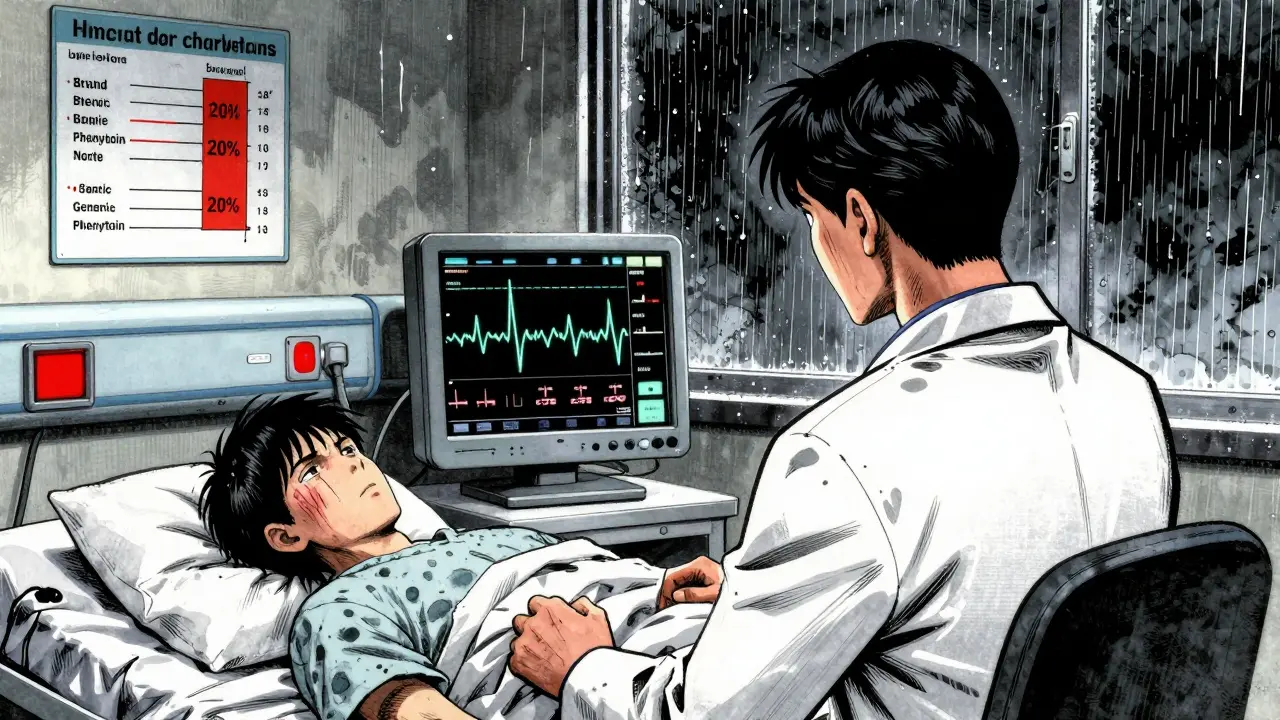
A review of 760 patients taking levetiracetam found that many reported increased seizures, blurred vision, depression, and memory problems after switching to generics. Nearly half of those patients had to go back to the brand-name version. Another study tracked 50 patients who had breakthrough seizures after switching to generic phenytoin-47% of them had drug levels below the therapeutic range at the time of seizure.
Why? Phenytoin and carbamazepine have complex absorption patterns. Their generics aren’t always bioequivalent. One study found that different generic brands of tacrolimus varied in active ingredient content by up to 20%. That’s not a glitch-it’s a systemic issue.
Seventy-three U.S. states have laws restricting pharmacists from substituting antiepileptic generics without prescriber approval. That’s because neurologists know the risk. A seizure isn’t just inconvenient-it can cause brain damage, falls, or death.
Immunosuppressants: Transplant Patients on Edge
For transplant patients, a generic switch can mean organ rejection. Cyclosporine is the classic example. In one study, 13 out of 73 patients (17.8%) needed a dose adjustment within two weeks of switching from Neoral to a generic. Trough levels jumped from 234 ng/mL to 289 ng/mL-enough to cause kidney toxicity. Meanwhile, none of the patients who stayed on the brand needed changes.
Reddit threads from transplant communities are full of similar stories: “My creatinine spiked after switching generics.” “I had a rejection episode two weeks later.” “I’ve been stable for 8 years-then the pharmacy switched me.”
Even tacrolimus, which has shown bioequivalence in controlled trials, isn’t risk-free. Different generic manufacturers produce products with varying active ingredient levels. One brand might deliver 96-99%, another 100-120%. If you switch from one generic to another, you’re still changing exposure.

What Do Pharmacists and Doctors Really Think?
A 2018 survey of 710 U.S. pharmacists found that 82% would substitute generic NTI drugs. But 41% recommended extra monitoring after the switch. For antiepileptics, 62% expressed serious concerns about seizure risk.
Doctors are even more cautious. A national survey of neurologists showed that 70% avoid switching patients on antiepileptics unless absolutely necessary. Transplant specialists routinely check drug levels before and after any substitution. Warfarin clinics now have protocols that require INR checks within days of a generic switch.
Yet, in practice, substitutions often happen without the patient or prescriber even knowing. Pharmacies are incentivized to dispense generics. Insurance plans penalize brand-name prescriptions. Patients aren’t told. And when something goes wrong, the blame gets passed around-between the pharmacy, the doctor, the manufacturer.
What Should You Do If You’re on an NTI Drug?
If you’re on an NTI drug, here’s what you need to do:
- Ask your doctor: Is your drug on the NTI list? If so, ask whether switching is safe for you.
- Check your prescription: Look at the name on the bottle. If it changes unexpectedly, ask why.
- Request brand-only: If your drug is critical (like cyclosporine, phenytoin, or warfarin), ask for a “dispense as written” or “do not substitute” note on your prescription.
- Monitor closely: If you’re switched, get lab tests done sooner than usual. For warfarin: INR in 5-7 days. For cyclosporine: trough level in 1-2 weeks. For phenytoin: blood level check within 10 days.
- Report side effects: If you feel worse-more seizures, unusual bruising, dizziness, fatigue-call your doctor immediately. Don’t wait.
The Bigger Picture: Cost vs. Risk
Generic drugs save the U.S. healthcare system billions. That’s a good thing. But NTI drugs aren’t like ibuprofen or lisinopril. They’re high-risk, high-stakes medications. The FDA’s one-size-fits-all bioequivalence standard doesn’t reflect the real-world consequences of substitution.
Other countries have already tightened their rules. The FDA is moving slowly, but they’ve started drafting product-specific bioequivalence guidelines for NTI drugs. That’s a step in the right direction. Meanwhile, therapeutic drug monitoring is expected to rise by 15-20% over the next five years as more patients are affected by substitutions.
Patients deserve transparency. They deserve to know when their medication changes. And they deserve to be protected-not just from disease, but from the unintended consequences of cost-cutting.






Chiruvella Pardha Krishna
February 15, 2026 at 10:40
The FDA's 80-125% bioequivalence standard for NTI drugs is not a scientific benchmark-it's a policy compromise dressed in white coats. We treat life-sustaining medications like commodities, as if the body operates on supply-chain logic. A thyroid hormone isn't a box of cereal. You don't swap brands and hope for the best. The system doesn't fail because of bad actors-it fails because it refuses to acknowledge that biology doesn't care about cost-cutting spreadsheets.
When a transplant patient's creatinine spikes after a pharmacy switch, it's not an anomaly. It's a predictable outcome of a system that prioritizes profit over precision. We call it "generic"-as if the medicine itself is somehow less valuable, not the lives it holds in balance.
The real scandal isn't that substitutions happen. It's that we've normalized them. And then we blame patients for not monitoring closely enough. As if vigilance is a substitute for systemic accountability.