
Imagine knowing if your cancer treatment is working before your next scan. No needles, no surgery, just a simple blood draw that tells your doctor what’s happening inside your body at a molecular level. That’s the reality of liquid biopsy today - and it’s already changing how cancer is managed.
Traditional biopsies require cutting into tissue, often from hard-to-reach tumors. They’re painful, risky, and can’t be done often. A single sample might miss key mutations because tumors aren’t uniform. One part might have a targetable mutation, another might be resistant. Liquid biopsy solves this by analyzing fragments of DNA shed by tumors into the bloodstream - called circulating tumor DNA, or ctDNA. It’s not just a backup. For many patients, it’s becoming the go-to tool.
What Exactly Is ctDNA?
When cancer cells die, they break apart and release bits of their DNA into the blood. This is ctDNA. It’s not the same as the DNA from healthy cells. It carries the same genetic errors that made the tumor grow - mutations in genes like EGFR, KRAS, BRAF, or PIK3CA. These mutations act like fingerprints, letting doctors track the cancer’s behavior.
What makes ctDNA powerful is how quickly it changes. If a drug stops working, the cancer often develops a new mutation to escape. With a tissue biopsy, you’d need to repeat the procedure. With liquid biopsy, you can test again in a week. Studies show ctDNA can detect resistance mutations 3 to 6 months before tumors show up on scans. That’s not guesswork - it’s real-time feedback.
How Is It Done?
The process starts with a standard blood draw. About 10 milliliters - less than two teaspoons - is enough. The sample is processed quickly to prevent healthy DNA from breaking down. Then, labs use highly sensitive tools to find the cancer signals.
- Digital droplet PCR (ddPCR) can spot one mutant DNA molecule among 10,000 normal ones. Great for tracking known mutations.
- Next-generation sequencing (NGS) scans hundreds of genes at once. Useful when you don’t know what to look for.
- Methylation analysis looks at chemical tags on DNA. Cancer DNA often has abnormal methylation patterns, even before mutations appear. This boosts detection by 20-30% in early-stage cancers.
Some newer methods even analyze the size of DNA fragments. Tumor DNA tends to be shorter than healthy DNA. Combine that with methylation and mutation data, and accuracy climbs even higher.
Why It Beats Traditional Biopsies
Let’s say you have metastatic lung cancer. Your doctor wants to know if the drug you’re on is still working. A tissue biopsy? It’s risky if the tumor is near a major blood vessel. It’s also expensive and takes weeks to get results.
A liquid biopsy? Done in 15 minutes. No anesthesia. No recovery. Results in 7-10 days. And because it samples DNA from all tumor sites, it captures the full picture - not just one spot.
Here’s what liquid biopsy does better:
- Tracks tumor evolution - Tumors change over time. Liquid biopsy sees those changes as they happen.
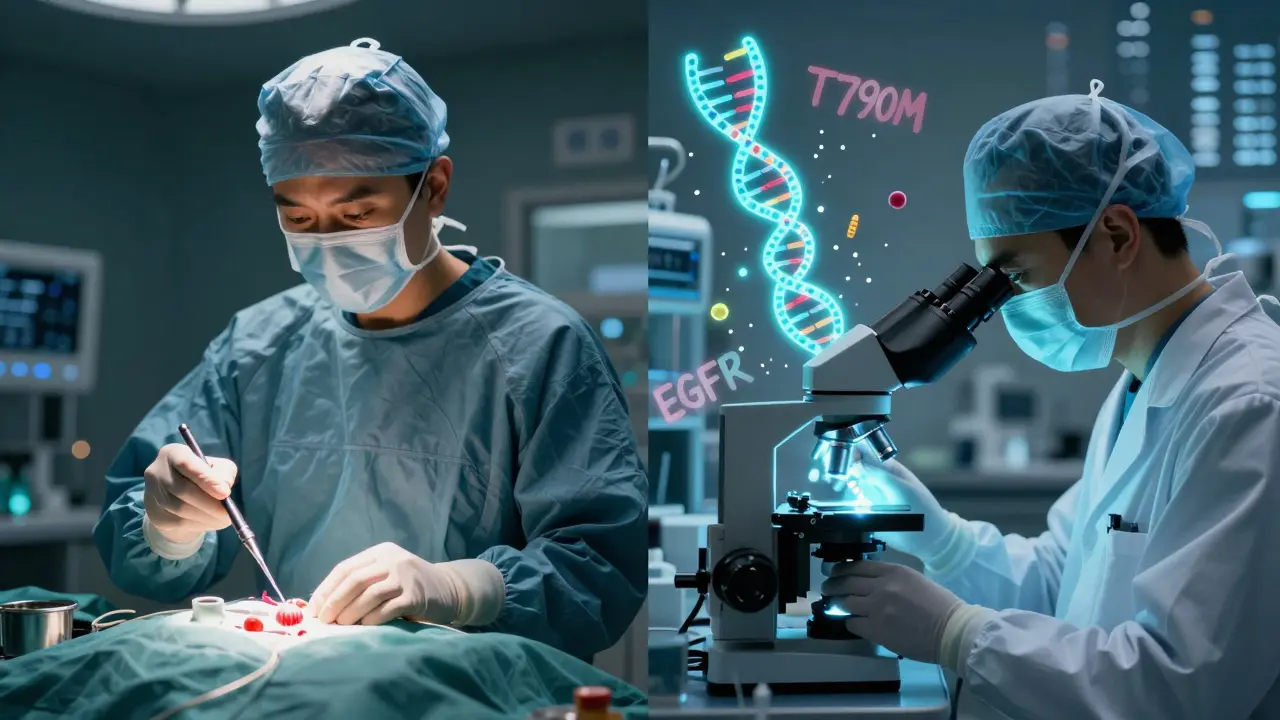
- Identifies resistance - When a drug stops working, ctDNA often reveals why - a new mutation like T790M in EGFR - before symptoms appear.
- Detects recurrence early - After surgery, ctDNA can show if cancer cells remain. In colorectal cancer, patients with detectable ctDNA after surgery have a 90% chance of recurrence within 2 years. Those without? Less than 10%.
- Works when tissue isn’t available - About 20-30% of patients don’t have enough tissue for testing. Liquid biopsy fills that gap.
At MD Anderson Cancer Center, about 40% of phase I clinical trials now use ctDNA as a biomarker. Oncologists report a 25-30% drop in repeat tissue biopsies for metastatic patients.
Where It Falls Short
Liquid biopsy isn’t perfect. It’s not a magic bullet.
For early-stage cancers - stage I or II - ctDNA levels can be so low that tests miss them. Detection rates range from 50% to 70%, compared to 80-90% in stage IV. That’s why it’s not yet used for routine screening in low-risk people.
Some cancers barely shed DNA. Brain tumors, indolent lymphomas, and certain kidney cancers often give false negatives. Prostate cancer, for example, releases very little ctDNA, making it less reliable.
Then there’s noise. Not all DNA mutations come from cancer. As we age, blood cells can develop harmless mutations - a phenomenon called clonal hematopoiesis. In patients over 65, this happens in 10-15% of cases. Labs must filter these out, or risk misdiagnosing a healthy mutation as cancer.
And results vary. One lab’s test might detect a mutation another misses. Standardization is still catching up. In multicenter studies, up to 25% of results differ due to how samples are handled or analyzed.
Real-World Impact
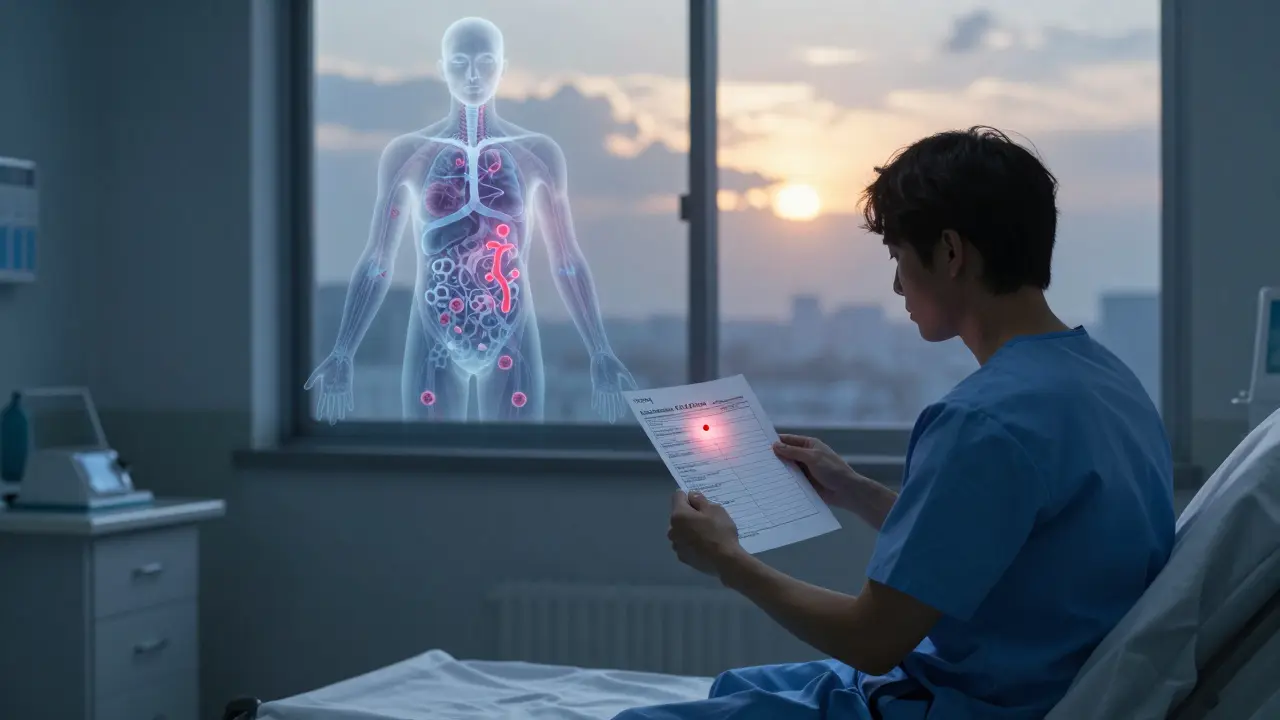
Take a 58-year-old woman with advanced lung cancer. Her first biopsy showed an EGFR mutation. She started on a targeted drug. After four months, her scan looked stable. But her liquid biopsy showed a new T790M mutation - a known resistance marker. Her doctor switched her to a next-gen drug before she even felt worse. She stayed in remission for another 14 months.
Or a 42-year-old man after colon cancer surgery. His ctDNA was negative. Six months later, it turned positive. A scan confirmed a tiny liver recurrence. He got localized radiation. No chemo. No major surgery. He’s now cancer-free.
These aren’t rare cases. In lung cancer, ctDNA testing found targetable mutations in 92% of patients where tissue was insufficient. In breast cancer, it predicted recurrence 6-11 months before imaging. That’s time to act - before the cancer spreads again.
What’s Next?
The future is multi-analyte. Instead of just looking at mutations, labs are combining:
- ctDNA mutations
- DNA methylation patterns
- Fragment size profiles
- Proteins from tumor-educated platelets
Early data suggests this combo can detect stage I cancers with over 95% accuracy. Methylation, in particular, is promising because it changes early - sometimes before cancer forms. Researchers are already testing blood tests for five cancers (lung, colon, breast, pancreatic, ovarian) in high-risk groups.
AI is also stepping in. Machine learning models now analyze the shape of DNA fragments to spot cancer patterns. One study showed AI improved detection accuracy by 15-20% compared to traditional methods.
Regulatory bodies are catching up. The FDA has approved 12 liquid biopsy tests since 2020, including Guardant360 CDx and FoundationOne Liquid CDx. NCCN guidelines now recommend liquid biopsy for EGFR testing in lung cancer when tissue isn’t available. ASCO updated its 2023 guidelines to include it as a first-line option.
The global market is exploding - projected to hit $19.5 billion by 2030. But adoption isn’t even. Top academic centers offer it to 60-70% of patients. Community clinics? Only 25-30%. Cost and interpretation complexity are the main barriers.
What Should You Ask Your Doctor?
If you or a loved one has advanced cancer, ask:
- Is liquid biopsy an option for my type of cancer?
- Can we test for ctDNA before starting treatment to find targetable mutations?
- Can we use it to monitor how I’m responding - instead of waiting for a scan?
- What happens if the test shows a mutation I didn’t have before?
- Is this test covered by my insurance?
Don’t assume it’s only for late-stage cancer. For some, it’s becoming part of routine follow-up - like a blood pressure check, but for your tumor.
Final Thoughts
Liquid biopsy isn’t replacing tissue biopsy. But it’s changing the game. It’s turning cancer from a static diagnosis into a dynamic condition we can track in real time. It’s giving patients fewer invasive procedures, faster answers, and more control.
It’s not perfect. But in the right hands, with the right cancer type, it’s already saving lives - not by curing, but by helping doctors act before it’s too late.
Can liquid biopsy replace a tissue biopsy completely?
No - not yet. Tissue biopsy is still needed for initial diagnosis and to confirm cancer type. Liquid biopsy works best as a follow-up tool to monitor treatment, detect resistance, or find recurrence. It’s a companion, not a replacement.
How often should ctDNA be tested during treatment?
It depends on the cancer and stage. During active treatment, testing every 4-8 weeks is common. After treatment, surveillance tests every 3-6 months help catch recurrence early. Some patients get tested before each new drug cycle. Your oncologist will tailor the schedule.
Is liquid biopsy covered by insurance?
In the U.S., many insurers cover liquid biopsy for advanced non-small cell lung cancer, colorectal cancer, and breast cancer - especially when tissue isn’t available. Coverage varies by plan and test. Always check with your provider. In Australia, Medicare covers some tests under specific criteria, but many are still out-of-pocket.
Can liquid biopsy detect cancer before symptoms appear?
For now, not reliably in average-risk people. Current tests work best in those already diagnosed. But research is moving fast. Multi-cancer early detection (MCED) tests - looking at methylation and fragmentation - are in clinical trials. These may soon screen for multiple cancers in high-risk groups, like those with family history or genetic mutations.
What if the test shows a mutation I didn’t have before?
That’s often a sign the cancer is evolving. It doesn’t mean the test was wrong. Resistance mutations are common. Your doctor will compare it to your original tumor profile and decide if a new treatment is needed. Sometimes, it’s just clonal hematopoiesis - a harmless blood cell change. Labs flag these, but your oncologist should review every result carefully.





Anil bhardwaj
February 26, 2026 at 16:10
Been using this for my dad's lung cancer. His last scan was clean, but ctDNA showed a tiny T790M spike. Doc switched meds before he even felt off. No more needles, no more waiting. Just a blood draw and bam - we're ahead of the game.
Wish more docs knew about this. It's not magic, but it's the closest thing we got.