Ever wonder how generic drugs end up on pharmacy shelves for a fraction of the price of brand-name pills? The answer lies in something called an ANDA - the Abbreviated New Drug Application. It’s not a fancy term, but it’s one of the most powerful tools in modern medicine for making life-saving drugs affordable. Since 1984, this single regulatory pathway has saved the U.S. healthcare system over $2 trillion. And it’s why you can buy a 30-day supply of generic lisinopril for $4 instead of $150.
What Exactly Is an ANDA?
An ANDA is a formal request submitted to the U.S. Food and Drug Administration (FDA) asking permission to sell a generic version of a drug that’s already been approved. It’s called "abbreviated" because it doesn’t require the same massive clinical trials as the original drug. Instead, it leans on data already proven safe and effective by the brand-name version.The original drug - known as the Reference Listed Drug (RLD) - had to go through years of testing, animal studies, and human trials to get its New Drug Application (NDA) approved. The generic version? It just needs to prove it’s the same in every way that matters: same active ingredient, same strength, same way of taking it (pill, injection, cream), and same effect in the body.
The ANDA process was created by the Hatch-Waxman Act of 1984. Before that, generic manufacturers had to reinvent the wheel - running their own expensive trials even though the drug’s safety was already known. The law changed that. It gave them a shortcut: if you can show your drug works the same way as the original, you don’t need to repeat the clinical trials. That’s the whole point of "abbreviated."
How Does an ANDA Prove It’s the Same?
The FDA doesn’t just take a company’s word for it. There are two big tests every ANDA must pass:- Pharmaceutical equivalence: Your generic pill must contain the exact same active ingredient, in the same amount, in the same form (tablet, capsule, liquid) as the brand drug.
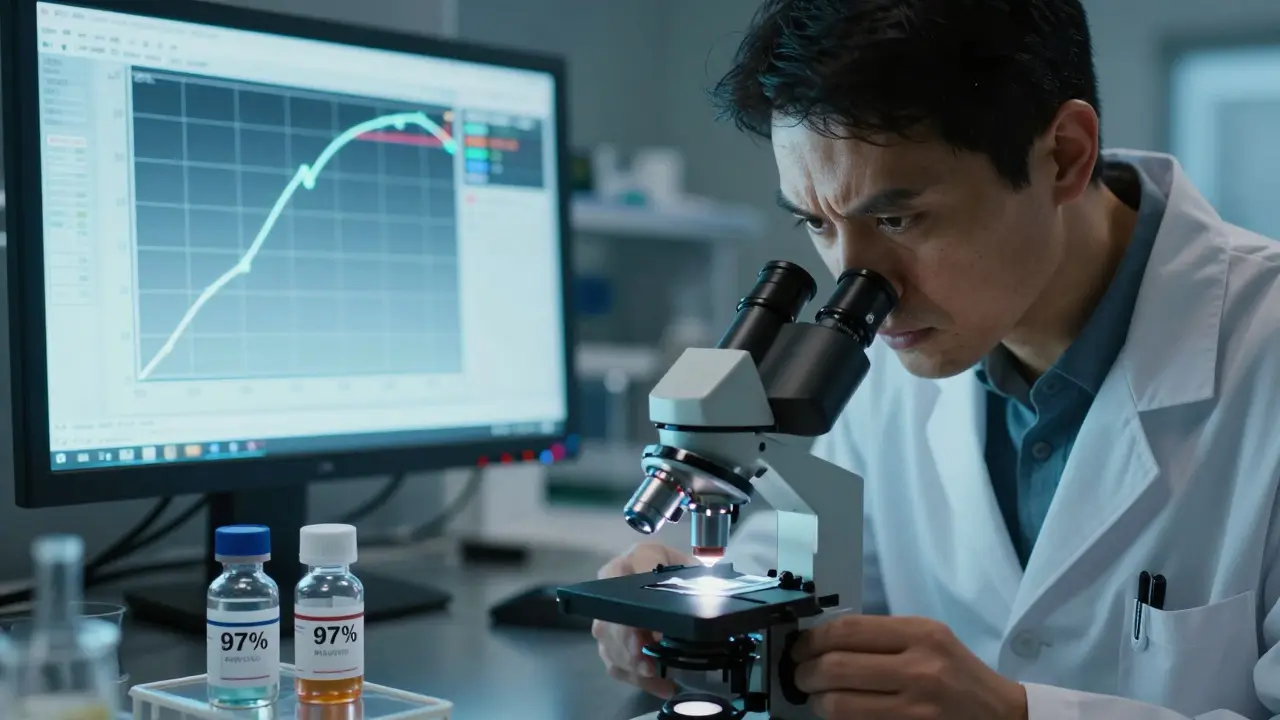
- Bioequivalence: This is the real test. It proves your body absorbs the drug the same way. Researchers give 24 to 36 healthy volunteers both the brand drug and your generic, then measure how much of the drug enters the bloodstream and how fast. The results must fall within 80% to 125% of the brand drug’s performance for both total exposure (AUC) and peak concentration (Cmax). If it’s outside that range, the FDA says no.
That’s not guesswork. It’s science. A 2022 FDA review of over 11,000 approved generics found 97% matched their brand-name counterparts in therapeutic effect. That means if your doctor prescribes you a brand-name statin and you switch to the generic, your cholesterol levels won’t change.
What’s in an ANDA Submission?
It’s not just about proving equivalence. The FDA demands detailed proof of quality and manufacturing control. Every ANDA must include:- Full details of the drug’s chemical makeup and how it’s made
- Stability data showing the drug won’t break down before its expiration date
- Proof the manufacturing facility meets strict quality standards (GMP)
- Labeling that matches the original - except for the brand name and manufacturer
Minor differences are allowed - like the color of the pill or the shape - as long as they don’t affect how the drug works. You might get a blue capsule instead of a red one, but the active ingredient and how it behaves in your body? Identical.
Each approved ANDA gets its own six-digit number - like ANDA 214455 for the generic version of Eliquis. You can look up these numbers on the FDA’s Drugs@FDA database. It’s public, transparent, and easy to verify.
ANDA vs. NDA: The Big Difference
Think of it this way: an NDA is like building a new house from scratch. You need permits, blueprints, inspections, and years of work. An ANDA is like buying a house that’s already been inspected and approved - you just need to prove it’s the same as the original.- NDA (New Drug Application): Takes 10-15 years. Costs around $2.6 billion. Requires full clinical trials.
- ANDA (Abbreviated New Drug Application): Takes 3-4 years. Costs $1-5 million. Uses existing safety data.
The FDA’s review time for an ANDA is 10 months under current rules (GDUFA). For a brand drug, it’s 12 months. That speed matters. In 2022 alone, 724 generic drugs were approved - each one saving patients and insurers millions.
Why This Matters for Patients
Generic drugs aren’t "second-rate." They’re the same medicine, just cheaper. In 2023, 90% of all prescriptions filled in the U.S. were for generics. But those generics only made up 23% of total drug spending. That’s a $313 billion annual savings for patients, insurers, and Medicare.Take Humira, the blockbuster arthritis drug. When its patent expired in 2023, 12 different generic versions hit the market within months. Prices dropped by over 80% in the first year. That’s the power of the ANDA pathway.
For people on fixed incomes, for those without insurance, for seniors on Medicare - this isn’t just about cost. It’s about access. A generic version of insulin, for example, can mean the difference between managing your condition and going without.
Challenges and Limitations
It’s not perfect. The ANDA system works best for simple, small-molecule pills - the kind you swallow. It struggles with complex products like inhalers, topical creams, or injectables where the drug’s delivery matters as much as the ingredient itself.For example, a generic inhaler isn’t just about the active drug. The propellant, the spray mechanism, how the medicine gets into the lungs - all of it affects performance. The FDA’s 2022 Complex Generic Drug Program was created to handle these tougher cases, but approval rates are still lower. One industry survey found 68% of generic manufacturers face major hurdles when submitting ANDAs for these complex products.
Another issue? Manufacturing. Over 80% of generic drug ingredients come from just two countries: India and China. If there’s a supply chain disruption - like a factory shutdown or regulatory inspection - shortages can happen. Experts warn this creates a hidden vulnerability in the system.
And then there’s the patent game. Generic companies must certify whether they’re challenging any patents on the original drug. If they do, the brand company can sue - triggering a 30-month delay in approval. That’s why some generics don’t hit the market until years after patent expiration.
Who’s Behind the ANDA?
The generic drug industry is dominated by a few big players: Teva, Viatris (formerly Mylan), Sandoz, and Amneal. Together, they control nearly half the U.S. market. But hundreds of smaller companies also file ANDAs - especially for high-demand, low-cost drugs like metformin or atorvastatin.Companies with dedicated regulatory teams - people who know the FDA’s rules inside out - have a much better shot at approval. Data shows they get first-cycle approval 42% of the time, compared to just 28% for those without specialized teams.
The FDA now requires electronic submissions through the eCTD system. Since 2017, this has cut administrative errors by 60%. It’s not glamorous, but it matters. A misplaced form or unclear data table can delay approval by months.
What’s Next for ANDAs?
The FDA’s new GDUFA IV program, launched in 2023, aims to raise the first-cycle approval rate from 65% to 90% by 2027. That means fewer back-and-forths, faster access, and more savings.More complex generics are coming - nasal sprays, injectables, topical antifungals. The FDA is updating its guidelines to keep up. Analysts predict that by 2028, one in four generic drugs approved will be complex.
But the core mission hasn’t changed: make safe, effective drugs affordable. The ANDA pathway has done that for 40 years. And with over $1.7 trillion in projected savings between 2024 and 2033, it’s not going anywhere.
Is an ANDA the same as a generic drug?
No. An ANDA is the application submitted to the FDA to get approval for a generic drug. Once approved, the drug is called a generic. The ANDA is the paperwork; the generic is the medicine you buy at the pharmacy.
Do generic drugs work as well as brand-name drugs?
Yes. The FDA requires generics to be bioequivalent to the brand-name drug - meaning they work the same way in your body. Studies show 97% of approved generics match their brand counterparts in effectiveness. Switching from brand to generic won’t change your treatment outcome.
Why are generic drugs so much cheaper?
Because they don’t have to repeat expensive clinical trials. The original drug company already paid for the research. Generic manufacturers only need to prove their version is equivalent. That cuts development costs from billions to millions - and those savings get passed on to patients.
Can any drug have a generic version?
Not all. Drugs with complex delivery systems - like inhalers, injectables, or topical creams - are harder to replicate. Some drugs with very narrow therapeutic windows (where small dose changes cause big effects) also face challenges. And drugs still under patent protection can’t have generics until the patent expires.
How long does it take to get an ANDA approved?
Under current FDA rules, the review time is 10 months for a standard ANDA. But it can take longer if the application is incomplete or if there are patent disputes. The actual time from filing to market can be 3-5 years, depending on formulation complexity and patent status.
Are there risks with generic drugs?
The risks are minimal. The FDA holds generic drugs to the same quality standards as brand-name drugs. The main risk isn’t safety - it’s availability. If a manufacturing plant in India or China shuts down, shortages can occur. But the drug itself, once approved, is just as safe and effective.




Bhaskar Anand
February 21, 2026 at 13:01
This ANDA system is pure genius. India manufactures over 60% of the world's generics and we don't get enough credit. The FDA's bioequivalence standards are rigid but fair. No fluff. No nonsense. Just science. And yet Western media keeps painting Indian pharma as shady. Absolute nonsense. We follow WHO-GMP, we export to 150 countries, and we do it cheaper than anyone. If you're on insulin or blood pressure meds, thank a Indian lab technician, not a CEO in New Jersey.