
Living with Borderline Personality Disorder (BPD) can feel like walking through life with your nerves exposed. One moment you’re fine, the next you’re overwhelmed by rage, despair, or a crushing sense of emptiness. Impulses hit hard-self-harm, frantic calls to loved ones, sudden decisions to end relationships. It’s not weakness. It’s not attention-seeking. It’s emotional dysregulation-a core feature of BPD that makes everyday stress feel like a life-or-death emergency.
For decades, people with BPD were told they were "difficult" or "untreatable." Then came Dialectical Behavior Therapy (DBT). Developed by Dr. Marsha Linehan in the late 1980s, DBT wasn’t just another therapy. It was a revolution. It didn’t ask people to stop feeling so much. Instead, it taught them how to survive those feelings without destroying themselves.
What Makes DBT Different?
Most therapies focus on insight: "Why do you feel this way?" DBT flips that. It asks: "What can you do right now to get through this?" It’s practical, structured, and skill-based. You don’t wait for a breakthrough-you learn tools you can use while you’re in the middle of a crisis.
DBT combines two opposing ideas: acceptance and change. You learn to accept your emotions as real and valid-even the painful ones-while also building skills to change how you respond to them. This balance is what makes it work for people who feel constantly invalidated by others, and sometimes even by themselves.
Research backs this up. A landmark 2006 study by Linehan showed that people in DBT cut self-harm incidents by 46% compared to those getting standard care. By 2015, follow-up data showed suicide attempts dropped by 50% after one year of treatment. These aren’t small numbers. They’re life-changing.
The Four Core Skill Modules
DBT isn’t one skill. It’s four interconnected sets of skills, each designed to tackle a different part of the BPD experience. You don’t need to master them all at once. Start where you’re most stuck.
Mindfulness: Grounding Yourself in the Present
When you’re flooded with emotion, your mind races to the past or the future. Mindfulness pulls you back to now. It’s not about emptying your mind. It’s about noticing what’s happening without judging it.
There are two parts:
- What skills: Observe (notice thoughts, feelings, sensations), Describe (put words to them), Participate (get fully involved in the moment).
- How skills: Do it non-judgmentally (no "I’m bad for feeling this"), one-mindfully (focus on one thing at a time), effectively (do what works, not what feels right).
Studies show just eight weeks of mindfulness practice increases emotional regulation by 32% in people with BPD. You don’t need to meditate for hours. Try this: When you feel a wave of panic, pause. Name three things you can see, two you can hear, one you can feel. That’s mindfulness in action.
Distress Tolerance: Surviving the Unbearable
Some crises can’t be fixed right away. You can’t talk your way out of a panic attack. You can’t reason with a wave of suicidal thoughts. Distress tolerance teaches you how to get through the storm without making it worse.
Here are the most powerful tools:
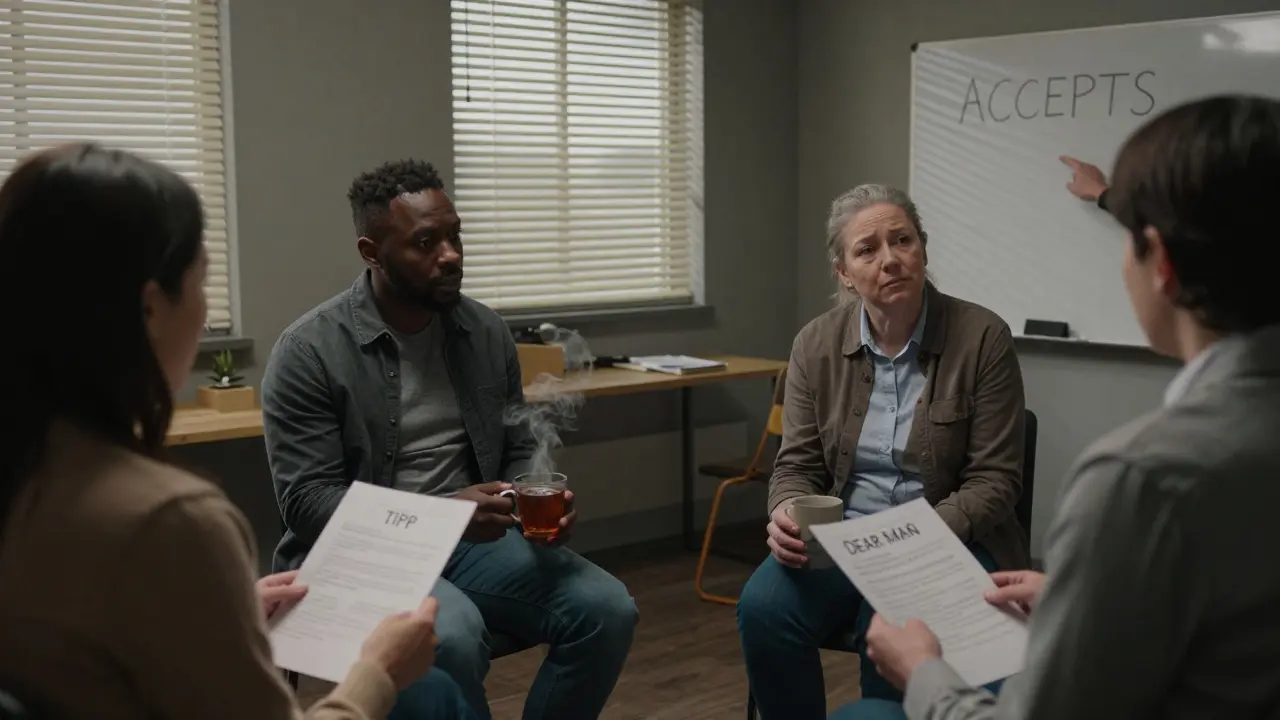
- TIPP: Temperature-splash cold water on your face or hold an ice pack. Intense exercise-do 20 jumping jacks. Paced breathing-inhale for 4, hold for 4, exhale for 6. Paired muscle relaxation-tense your fists while breathing in, release while breathing out.
- ACCEPTS: Activities-watch a funny video. Contributing-text someone who needs support. Comparisons-think of someone worse off. Emotions-watch a movie that matches your mood. Pushing away-temporarily set the problem aside. Thoughts-count backwards from 100. Sensations-rub your hands with lotion, chew mint gum.
- IMPROVE: Imagery-picture a safe place. Meaning-find purpose in the pain. Prayer-ask for strength, even if you’re not religious. Relaxation-breathe slowly. One thing in the moment-focus on your breath. Vacation-take a short break from the situation. Encouragement-say to yourself: "I can handle this. I’ve survived before."
One user on Reddit shared: "I used IMPROVE during a suicidal night. I didn’t feel better-but I didn’t hurt myself. For the first time in ten years, I made it through without self-harm."
Emotion Regulation: Understanding and Changing Your Feelings
Emotions aren’t the enemy. But when they’re too intense, too frequent, or too long-lasting, they take over. Emotion regulation helps you understand your feelings and reduce their power.
- PLEASE: Treat Physical Illness-see a doctor if you’re sick. Balanced Eating-don’t skip meals. Avoid mood-altering drugs-alcohol and drugs make emotions worse. Balanced Sleep-aim for 7-8 hours. Exercise-even a 10-minute walk helps.
- ABC: Accumulate positive emotions-do small things you enjoy every day. Build mastery-complete small tasks to feel capable. Cope ahead-plan for stressful situations before they happen.
- Opposite Action: If you feel like isolating, reach out. If you feel like lashing out, speak gently. If you feel like giving up, do one small thing. Acting opposite to your emotion can change how you feel.
After six months of consistent practice, people report a 40% drop in emotional reactivity. That means fewer outbursts, fewer breakdowns, fewer regrets.
Interpersonal Effectiveness: Navigating Relationships Without Losing Yourself
BPD often comes with intense, unstable relationships. You might idealize someone one day and hate them the next. You might say things you regret to avoid being abandoned. Interpersonal effectiveness teaches you how to ask for what you need, say no, and keep relationships healthy.
- DEAR MAN: Describe the situation. Express your feelings. Assert your request. Reinforce with a positive outcome. Stay Mindful-don’t get sidetracked. Appear Confident-even if you’re not. Negotiate-be willing to compromise.
- GIVE: Be Gentle. Show Interest in the other person. Validate their feelings. Use an Easy manner-smile, relax your tone.
- FAST: Be Fair to yourself and others. No Apologies for having needs. Stick to your values. Be Truthful.
A 2023 study from McLean Hospital found these skills improved relationship satisfaction by 28%. One person wrote: "I used DEAR MAN with my partner during an argument. Instead of yelling, I said: ‘I feel scared when you leave the room. I need you to stay and talk.’ He stayed. We didn’t fight. It was the first time in years."
Crisis Planning: Your Personal Survival Kit
DBT doesn’t wait for a crisis to happen. It prepares you for it. A crisis plan is your go-to guide when you’re too overwhelmed to think clearly.
Start with this:
- Identify your top 3 warning signs-e.g., "I stop sleeping," "I delete all my photos," "I text my ex at 3 a.m."
- List your top 3 distress tolerance skills that work for you-e.g., TIPP, cold shower, walking around the block.
- Write down 3 people you can call-preferably someone who knows about your BPD and won’t panic.
- Include a list of emergency contacts: therapist, crisis line, local ER.
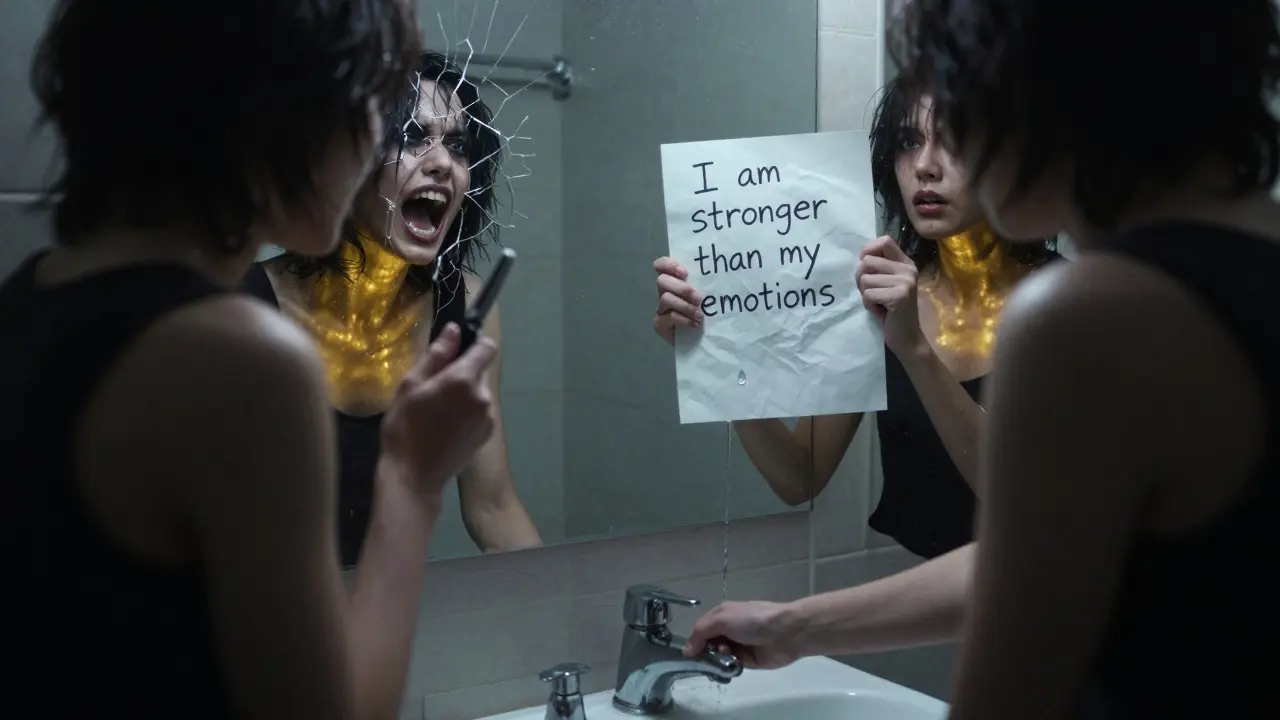
- Add a personal affirmation: "I am not my emotions. I have survived before. I will survive this."
Keep this plan on your phone, in your wallet, taped to your mirror. When you’re in crisis, you won’t have the energy to search for it. You need it right there.
The "STOP" skill is another lifesaver: Stop what you’re doing. Take a step back. Observe your thoughts, feelings, body. Proceed mindfully-choose your next move, don’t react.
How DBT Compares to Other Treatments
DBT isn’t the only option, but it’s the most researched for BPD. Here’s how it stacks up:
| Treatment | Reduction in Self-Harm | Time Commitment | Best For |
|---|---|---|---|
| DBT | 46% reduction | 6-12 months, 2-3 hrs/week | Chronic self-harm, emotional flooding, suicidal urges |
| Mentalization-Based Therapy (MBT) | 22% reduction | 12-18 months, weekly | Identity confusion, attachment issues |
| Schema Therapy | 28% reduction | 12-24 months, weekly | Deep-seated beliefs about being unlovable |
| STEPPS | Comparable to DBT for symptoms | 20 weeks, group only | People who can’t commit to long-term therapy |
DBT wins when it comes to immediate crisis management. It gives you tools you can use in the moment. Other therapies dig deeper into past wounds or personality patterns-but they don’t always help you survive the next 10 minutes.
What to Expect When You Start
DBT isn’t easy. It’s not magic. You’ll be asked to do homework-track your emotions, practice skills, fill out worksheets. Some days, you’ll hate it. You’ll think, "This won’t work. I’m too broken."
That’s normal.
Most people feel worse before they feel better. The first month is often the hardest. You’re learning to sit with pain instead of running from it. Emotional flooding is common. Compliance with homework is low at first-only 40% stick with it in the first three months. But by month six, 75% are doing it regularly.
You’ll need:
- Weekly individual therapy (1 hour)
- Weekly skills group (2 hours)
- Access to 24/7 phone coaching
There are only about 1,842 certified DBT therapists worldwide. If you can’t find one near you, look for telehealth options. Many clinics now offer virtual DBT programs. Apps like DBT Coach and Virtual Reality DBT are helping people practice skills at home-with 68% adherence rates in recent trials.
Real Stories, Real Results
On Reddit’s r/DBT community, people share daily wins:
- "I used the GIVE skill with my mom. Instead of yelling, I said, ‘I know you’re worried. I’m trying.’ She cried. We hugged."
- "I had a panic attack at work. I used TIPP: ice on my neck, 20 squats, slow breathing. I didn’t quit. I didn’t cry. I finished my shift."
- "I kept the PLEASE worksheet on my fridge. I started sleeping 7 hours. I stopped drinking. My mood stabilized."
These aren’t outliers. They’re people who learned how to survive their own minds.
Challenges and Barriers
DBT isn’t perfect. Some people find the structure too rigid. Others struggle with the time commitment. A third of participants drop out before finishing. That’s not failure-it’s a sign the system needs to adapt.
Access is still a problem. Only 12% of rural U.S. communities have a certified DBT provider. Insurance coverage varies. Some plans only cover 12 sessions a year. But telehealth has improved access by 28% since 2020.
Therapist burnout is real. DBT teams face high turnover rates. That’s why the Linehan Institute now offers a new "DBT-Crisis Survival" certification-focusing on acute crisis skills for providers who need to help more people faster.
And yes, some experts argue DBT doesn’t go deep enough. Dr. Joel Paris says it focuses too much on behavior and not enough on personality change. But for someone in active crisis? Behavior change is the first step to survival.
You Don’t Have to Do This Alone
Borderline Personality Disorder doesn’t define you. It’s a condition you live with-not your identity. And you don’t need to fix everything at once. Start with one skill. One day. One crisis.
Maybe today, you try TIPP. Maybe tomorrow, you write your crisis plan. Maybe next week, you use DEAR MAN with someone you love.
Progress isn’t linear. There will be setbacks. But every time you use a skill instead of self-harming, you’re rewiring your brain. Every time you survive a crisis, you prove to yourself: "I am stronger than my emotions."
DBT doesn’t promise a perfect life. It promises a survivable one. And for many people with BPD, that’s enough to keep going.
Can DBT cure Borderline Personality Disorder?
DBT doesn’t "cure" BPD, but it significantly reduces symptoms. Studies show it cuts self-harm by nearly half and suicide attempts by 50% within a year. Many people reach a point where their symptoms no longer disrupt their daily lives. BPD is a chronic condition, but with DBT, it becomes manageable.
How long does DBT take to work?
Most people start seeing improvements in 3-6 months. The full program usually lasts 6-12 months. Skills like mindfulness and distress tolerance often show results faster-sometimes within weeks. Emotional regulation and interpersonal skills take longer to master. Consistency matters more than speed.
Can I do DBT on my own without a therapist?
You can learn DBT skills from books and apps, but full DBT requires professional support. The combination of individual therapy, group skills training, and 24/7 phone coaching is what makes it effective. Self-guided DBT can help with mild symptoms, but for severe emotional dysregulation or suicidal thoughts, working with a certified therapist is essential.
Is DBT only for women?
No. DBT was originally developed with women in mind, but it works equally well for men, teens, and non-binary individuals. Research now shows men with BPD benefit just as much from DBT as women. The skills are gender-neutral-they target emotion regulation, not identity.
What if I can’t afford DBT?
Many community mental health centers offer low-cost or sliding-scale DBT programs. Some universities train therapists and provide free services. Online groups like DBT Self-Help and Reddit’s r/DBT offer peer support. Free worksheets and audio guides are available from the Linehan Institute and NAMI. You don’t need to pay for everything to start using the skills.
Do I need a diagnosis to start DBT?
No. While DBT was designed for BPD, it’s now used for depression, PTSD, addiction, and emotional instability in general. If you struggle with intense emotions, impulsive behavior, or unstable relationships, you can benefit from DBT skills-even without a formal diagnosis.
Are DBT skills useful for people without BPD?
Absolutely. Mindfulness, distress tolerance, and emotion regulation are human skills. People with anxiety, ADHD, trauma, or even high-stress jobs use DBT techniques daily. You don’t need a diagnosis to benefit from learning how to pause before reacting or how to soothe yourself during stress.





Uzoamaka Nwankpa
January 4, 2026 at 13:19
DBT saved my life when nothing else did. I used to self-harm every week. Now, after 14 months, I’ve gone 8 months without a single incident. It’s not glamorous. It’s not quick. But it works if you show up.