When a generic drug company submits an Abbreviated New Drug Application (ANDA) to the FDA, it’s not a simple yes-or-no decision. Most applications don’t get approved on the first try. Instead, they get a deficiency letter - a formal notice listing exactly what’s wrong. These aren’t minor feedback notes. They’re roadblocks that can delay approval by over a year and cost millions. If you’re trying to bring a generic drug to market, understanding these letters isn’t optional. It’s survival.
What Exactly Is a Deficiency Letter?
A deficiency letter from the FDA is a detailed breakdown of why your ANDA doesn’t meet approval standards. It’s not a suggestion. It’s a requirement. The FDA doesn’t just say, “Your application is incomplete.” It tells you which section, which test, which data point is missing or flawed. These letters come after the initial review by the Center for Drug Evaluation and Research (CDER), and they’re the main reason why only about 52% of ANDAs get approved on the first cycle. The letter might point to problems in the drug substance (the active ingredient), the drug product (the final pill or injection), manufacturing processes, or bioequivalence data. Over 70% of major deficiencies are quality-related. That means the issue isn’t about marketing claims or labeling - it’s about whether the drug is safe, consistent, and truly equivalent to the brand-name version.The Top 5 Deficiencies in Generic Drug Applications
Based on FDA data from 2021 to 2024, here are the most common reasons generic applications get rejected:- Dissolution Issues - This is the #1 problem. The FDA requires that your generic drug releases its active ingredient at the same rate and extent as the brand-name drug. If your dissolution method doesn’t match physiological conditions - like using outdated equipment or testing only at pH 6.8 when the drug needs to dissolve in stomach acid (pH 1.2) - you’ll get flagged. About 23.3% of ANDAs fail here.
- Drug Substance Sameness - The active ingredient must be chemically and physically identical to the reference drug. For complex drugs like peptides, this means proving the same secondary structure, aggregation profile, and impurity profile. Without circular dichroism, FTIR, or size-exclusion chromatography data, you’re asking for trouble. This accounts for 19% of major deficiencies.
- Unqualified Impurities - If your drug contains impurities that haven’t been properly identified, quantified, or toxicologically evaluated, the FDA will reject it. This is especially true for mutagenic impurities under ICH M7 guidelines. Missing (Q)SAR data or failing to link impurities to degradation pathways is a frequent error. Around 20% of applications fail here.
- Elemental Impurities - The FDA now requires strict control of heavy metals like lead, cadmium, and mercury under ICH Q3D. Many applicants think “we’ve always used this supplier” is enough. It’s not. You need validated analytical methods, risk assessments, and data showing levels are below safety thresholds. This affected 13% of submissions in 2024.
- Manufacturing Process Gaps - The FDA doesn’t just want your final product. They want to know how you make it. If your process isn’t well-characterized, if your batch sizes don’t reflect commercial scale, or if you can’t prove consistency across batches, you’ll get a deficiency. This is especially common for modified-release tablets and topical products.
Why Do These Problems Keep Happening?
It’s not because companies are careless. It’s because the gap between academic research and commercial manufacturing is huge. Many small companies develop their drug in a lab using small-scale equipment and then assume it’ll work at 10,000-liter production volumes. It doesn’t. The FDA expects you to prove your process is robust - not just once, but across multiple batches, under varying conditions. Another big issue? Misunderstanding the Bioequivalence Review Manual. The FDA’s guidance on study design for complex products like extended-release tablets or inhalers is detailed and specific. Applicants often design studies that look right on paper but don’t meet the agency’s technical requirements. About 30% of bioequivalence deficiencies come from this kind of misinterpretation. And then there’s documentation. Applications with thin, vague development reports get flagged more often than those with clear, step-by-step explanations. The FDA isn’t asking for a novel - they’re asking for a forensic audit trail. If you can’t show how you got from idea to final product, they won’t approve it.
Who Gets Hit the Hardest?
Not all companies face the same odds. Startups and firms with fewer than 10 approved ANDAs have deficiency rates 22% higher than established players with 50+ approvals. Why? Experience. They’ve seen these letters before. They know what the reviewers are looking for. They’ve built internal checklists. They’ve had pre-submission meetings with the FDA. Product complexity matters too. Standard immediate-release pills have a deficiency rate around 40%. But for complex generics - peptides, modified-release tablets, topical creams - that number jumps to 40-65%. These products require more testing, more data, and more precision. The FDA knows this. They’ve created specialized review teams just for these products. Even the dollar value of the drug plays a role. Generics with projected annual sales over $100 million have 18% fewer deficiencies than low-revenue products. That’s not because big companies are smarter. It’s because they can afford to invest in better labs, better consultants, and better documentation.How to Avoid a Deficiency Letter
The good news? Most deficiencies are preventable. 1. Use pre-submission meetings. The FDA offers these for free. You send them your draft application, they give you feedback before you officially submit. Companies that use them see deficiency rates 32% lower. Don’t skip this. It’s your best shot at avoiding a costly redo. 2. Invest in dissolution method development. Don’t just copy the reference drug’s method. Test it across pH 1.2, 4.5, and 6.8. Use biorelevant media when appropriate. Validate your method with discrimination testing - prove it can tell the difference between good and bad batches. 3. Know your impurities inside and out. Run ICH M7 assessments early. Use computational models (QSAR) to flag potential mutagens. Don’t wait until the FDA asks for toxicology studies - those take 14-18 months to complete. 4. Document everything. Your development report should read like a detective’s case file. What did you try? What failed? Why did you choose this method? What data convinced you? The more transparent you are, the less the FDA has to guess. 5. Target the right products. If you’re new to ANDAs, start with simple immediate-release tablets. Avoid peptides or complex modified-release systems until you’ve built a track record. The learning curve is steep - it takes 18-24 months for most first-time applicants to consistently avoid major deficiencies.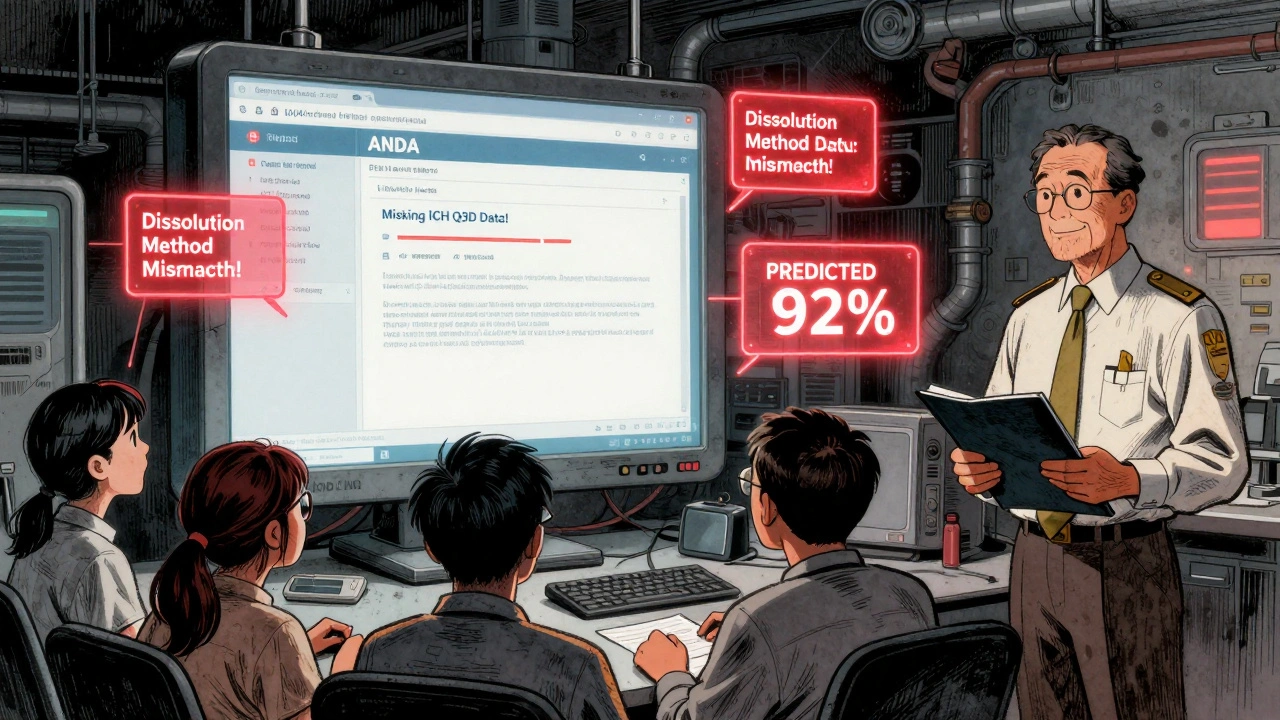
What’s Changing at the FDA?
The FDA isn’t standing still. They’re trying to fix the system. In 2023, they launched the First Cycle Generic Drug Approval Initiative. This includes new templates for deficiency responses, clearer guidance documents, and targeted training for reviewers. Early results? A 15% drop in dissolution-related deficiencies among participants. In April 2025, they released new template responses for the 10 most common deficiencies. Now, instead of guessing what the FDA wants, you can see exact examples of acceptable answers. By 2026, the FDA plans to roll out AI-assisted pre-submission screening. The system will scan your application before you even hit “submit” and flag common errors - like missing ICH Q3D data or mismatched dissolution apparatuses. Preliminary tests show this could cut preventable deficiencies by 35%. The goal? Raise first-cycle approval rates from 52% to 68% by 2027. That means more generic drugs hitting the market faster - and lower prices for patients.What Happens After You Get a Deficiency Letter?
If you get one, don’t panic. But don’t delay either. Each deficiency must be addressed point-by-point. You can’t just say, “We fixed it.” You need to show it. Submit new data. Include updated protocols. Attach validation reports. The FDA will re-review your application - and if you’ve answered everything clearly and completely, you’ll get approval. But here’s the cost: Each additional review cycle adds about $1.2 million in expenses. That’s R&D, testing, legal fees, and lost market time. For a small company, that can be devastating. The key is to treat the deficiency letter as a roadmap, not a rejection. Every point they raise is a chance to make your product better. And in the end, that’s what the FDA wants - a safe, effective, affordable drug for patients.Final Takeaway
Deficiency letters aren’t punishment. They’re feedback. The FDA doesn’t want to block generic drugs. They want to make sure they’re safe and effective. The companies that succeed aren’t the ones with the biggest budgets - they’re the ones who listen, learn, and prepare. If you’re submitting an ANDA, treat every section like it’s being reviewed by someone who’s seen 500 applications - and knows exactly what’s missing. Don’t guess. Don’t rush. Don’t assume. Test. Document. Ask. And always, always make sure your data speaks louder than your hopes.What is a deficiency letter from the FDA for generic drugs?
A deficiency letter is a formal notice from the FDA that identifies specific issues in an Abbreviated New Drug Application (ANDA) that prevent approval. It lists missing data, flawed methods, or non-compliant processes that must be corrected before the application can be approved. These letters are not suggestions - they are mandatory requirements.
What are the most common reasons generic drug applications get rejected?
The top reasons include dissolution method failures (23.3% of applications), unqualified impurities (20%), drug substance sameness issues (19%), elemental impurity control gaps (13%), and manufacturing process inconsistencies. These are all quality-related problems that affect whether the generic drug is truly equivalent to the brand-name version.
How long does it take to resolve a deficiency letter?
Resolving a deficiency letter typically adds 6 to 18 months to the approval timeline. Impurity-related deficiencies requiring new toxicology studies can take 14-18 months alone. The time depends on how complex the issue is and how quickly you can generate and submit valid, FDA-acceptable data.
Can you avoid a deficiency letter entirely?
Yes - about 65% of major deficiencies are preventable. The key is thorough preparation: conducting pre-submission meetings with the FDA, validating methods under real-world conditions, fully characterizing impurities, documenting every decision, and starting with simpler products before tackling complex generics.
Do small companies have a better chance of approval than big ones?
No. Companies with fewer than 10 approved ANDAs have deficiency rates 22% higher than those with 50+ approvals. Experience matters. Larger companies invest more in quality systems, regulatory expertise, and pre-submission planning, which reduces errors before the application is even filed.
What’s new at the FDA to reduce deficiency letters?
The FDA launched the First Cycle Generic Drug Approval Initiative in 2023, introduced template responses for common deficiencies in April 2025, and is developing AI-powered pre-submission screening for 2026. These tools aim to help applicants fix errors before submission, reducing avoidable rejections and speeding up approvals.
How much does a deficiency letter cost a company?
Each additional review cycle adds approximately $1.2 million in costs, including extended R&D, additional testing, regulatory consulting, and delayed market entry. For high-value generics, this can mean losing tens of millions in potential revenue.


Kurt Russell
December 8, 2025 at 00:49
Bro, I’ve seen this play out 3x in my last job - companies think they can slap together an ANDA and call it a day. Nope. The FDA doesn’t care how ‘smart’ your lab tech is. If your dissolution profile doesn’t match the reference drug at pH 1.2, you’re done. I once watched a $40M project die because they used a USP II apparatus instead of a paddle-over-disk for a modified-release tablet. Don’t be that guy. Pre-submission meetings? Do them. Even if you think you’re ready. You’re not.