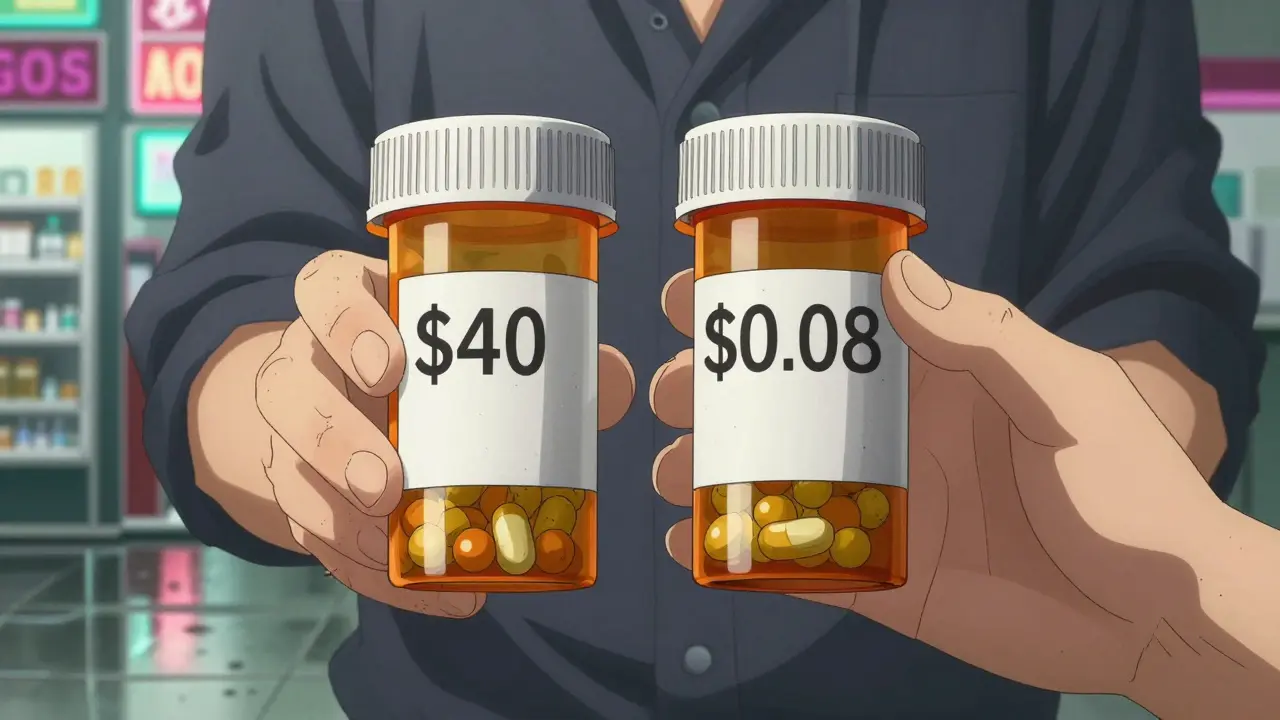
When you pick up a prescription, you might assume all generics are created equal. But that’s not true. Some generic drugs cost far more than others-even when they do the exact same thing. And here’s the kicker: sometimes, switching from one generic to another, or even to a combination pill, can slash your costs by 70%, 80%, or even 99%.
Take Crestor, for example. Before generics hit the market in 2015, a single pill cost $5.78. Today, the generic version? As low as $0.08 per pill. That’s a 99% drop. Same active ingredient. Same effect. Just cheaper. But not all generics follow this pattern. Some stay expensive for years, even when cheaper alternatives exist. Why? Because the generic drug market isn’t just about competition-it’s about structure, formulary decisions, and sometimes, sheer luck.
Why Some Generics Cost More Than Others
Not all generics are born equal. A 2022 study in JAMA Network Open looked at the top 1,000 generic drugs in Colorado and found 45 that were shockingly overpriced. These weren’t brand-name drugs. They were generics. And they were charging up to 15.6 times more than other generics with the same clinical effect. One drug cost $7.5 million annually. If patients had switched to the cheaper alternative, spending would’ve dropped to just $873,711. That’s an 88.3% savings.
What made these generics expensive? Often, it wasn’t manufacturing cost. It was market control. If only one or two companies make a generic, they can keep prices high. But when five or six companies enter the market, prices collapse. The FDA found that with three competitors, prices drop about 20% within three years. With more? You get 80% off.
And here’s where most people miss the real opportunity: therapeutic substitution. You don’t always need to switch to a different drug. Sometimes, switching to a different strength or form of the same drug saves you money. The same study found that 62% of high-cost generics had cheaper alternatives that were identical in effect-just packaged differently. A tablet instead of a capsule. A 10mg instead of a 20mg. A once-daily instead of twice-daily. These tiny changes often mean 95% savings.
Combination Drugs: The Hidden Savings Engine
Combination drugs-pills that mix two medications into one-are often seen as expensive. But when generics enter the market, they become savings powerhouses.
Take Advair Diskus. Before generics, it cost $334 per inhaler. In 2019, Wixela Inhub, the first generic version, hit the market at $115. That’s a 65.6% drop. Within a year, monthly spending on Advair and its generic combined fell from $337 million to $233 million. That’s $104 million saved every month-just from one drug.
Same thing happened with ICS/LABA inhalers for asthma and COPD. A 2022 study estimated that generic combination inhalers saved $941 million in the U.S. in one year. Patients didn’t lose effectiveness. They just paid less. And the savings didn’t stop there. A 2023 study from the Mark Cuban Cost Plus Drug Company showed that uninsured patients saved an average of $6.08 per prescription. For those on Medicare, it was $4.64. Private insurance? $3.69. Even small savings add up-especially when you refill every month.
And it’s not just inhalers. Combination drugs for high blood pressure, diabetes, and arthritis are now available as generics. Instead of buying three separate pills, you take one. Fewer pills mean fewer co-pays, fewer trips to the pharmacy, and fewer chances for a mistake. And yes-they’re cheaper.
Who’s Saving the Most?
The savings aren’t spread evenly. Uninsured patients saw the biggest drops. In one study, 28.9% of prescriptions for uninsured people had cost savings-more than double the rate for private insurance. Why? Because insurers often have negotiated prices that already lock in lower rates. The uninsured? They pay list price. So when a generic hits the market, they feel it immediately.
Medicaid patients saw almost no savings. Why? Because Medicaid already pays the lowest possible price for most drugs. Medicare saw moderate savings-because they’re negotiating harder but still have formulary restrictions. Private insurers? They’re caught between pharmacy benefit managers (PBMs) who control which drugs are covered and the manufacturers who push higher-priced generics.
This means if you’re uninsured or on Medicare, you have more power to save than you think. Ask your pharmacist: “Is there a cheaper version of this?” Or better yet: “Is there a combination pill that includes this drug?”
How to Find the Cheapest Option
You don’t need a degree in pharmacology to save money. Here’s how to do it:
- Check the Orange Book-the FDA’s list of approved generics with therapeutic equivalence ratings. Look for drugs marked “A.” That means they’re interchangeable.
- Ask your pharmacist if there’s a lower-cost version of your generic. Sometimes, the same drug comes in a different strength or form that’s cheaper.
- Request combination pills. If you take two separate drugs, ask if a combination version exists. It’s often cheaper and easier to manage.
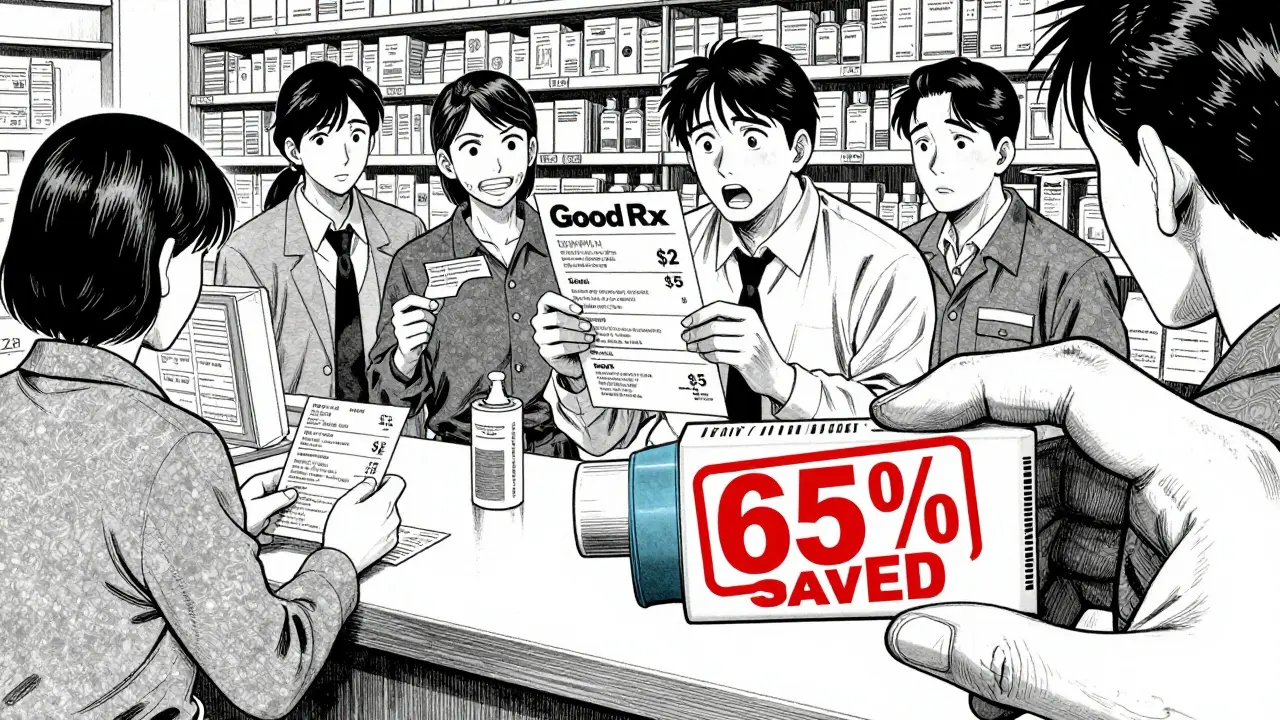
- Compare prices at different pharmacies. A generic might cost $5 at Walmart and $22 at your local pharmacy. Use GoodRx or similar tools to find the lowest price.
- Ask your doctor to review your formulary. Some insurance plans favor certain generics. If yours doesn’t, ask for a prior authorization or exception.
Don’t assume your prescription is already the cheapest option. A 2023 report from Tebra found that on average, generics cost 79% less than brand-name drugs-but that doesn’t mean all generics are cheap. Some are still overpriced.
The Bigger Picture: Why This Matters
Over the last decade, generic drugs saved the U.S. healthcare system $3.7 trillion. In 2023 alone, the top 10 generics saved $89.5 billion. That’s not just corporate profit-it’s real money back in patients’ pockets.
But there’s a dark side. The generic market is becoming more concentrated. The top 10 manufacturers control 40% of the market. Fewer competitors mean fewer price drops. And shortages are rising-from 166 in 2012 to 258 in 2022. When a drug is hard to find, prices spike.
That’s why patient advocacy matters. If you’re paying too much for a generic, speak up. Ask your doctor, your pharmacist, your insurer. Demand transparency. And don’t accept “that’s just how it is.”
What You Can Do Today
Here’s the simplest way to start saving:
- Take your prescription bottle to the pharmacy counter and ask: “Is there a cheaper version of this?”
- Search your drug name + “generic combination” on GoodRx or a similar site.
- If you take two pills a day, ask if a once-daily combo exists.
- If you’re uninsured, always check the cash price-it’s often lower than your insurance co-pay.
Generic drugs are supposed to be affordable. But the system doesn’t always make it easy. You have to know where to look. And once you do, the savings aren’t just numbers-they’re groceries, gas, rent, or peace of mind.
Are all generic drugs the same price?
No. Two generics with the same active ingredient can cost wildly different amounts. One might be priced at $5 per pill, while another for the same drug costs $40. This happens because of market competition, manufacturing costs, and how pharmacies negotiate with distributors. Always compare prices.
Can I ask my doctor to switch me to a cheaper generic?
Yes. Doctors can prescribe any FDA-approved generic, even if it’s not the one your insurance prefers. Just ask: “Is there a cheaper version of this medication?” or “Is there a combination pill that includes this drug?” Most doctors are happy to help if it doesn’t affect your treatment.
Why do some generic drugs have higher prices than brand names?
It’s rare, but it happens. Usually, it’s because the brand-name drug still has patent protections on its delivery system (like a special inhaler or slow-release formula), and the generic version hasn’t caught up. Or, there’s little competition-only one or two companies make it. That lets them keep prices high.
Do combination generics work as well as separate pills?
Yes. Combination generics contain the exact same active ingredients as the separate pills. The FDA requires them to be bioequivalent-meaning they work the same way in your body. Many patients prefer them because they reduce pill burden and improve adherence.
How do I know if my generic is the cheapest option?
Use tools like GoodRx, SingleCare, or your pharmacy’s price checker. Enter your drug name and zip code to see cash prices at nearby pharmacies. You can also ask your pharmacist to compare the cost of different strengths or forms of the same drug. Sometimes, a higher-strength tablet split in half is cheaper than buying two lower-strength pills.



Mike Dubes
March 4, 2026 at 11:14
i had no idea generics could be this wild. my last script for blood pressure meds was $45 at my local pharmacy, but i checked goodrx and found the same thing for $8 at walmart. just switched and saved a fortune. why do they even make us pay list price when the real cost is pennies? this is insane.
also, my pharmacist said i could split a 20mg tablet instead of buying two 10s - saved me another $12 a month. dumb system.