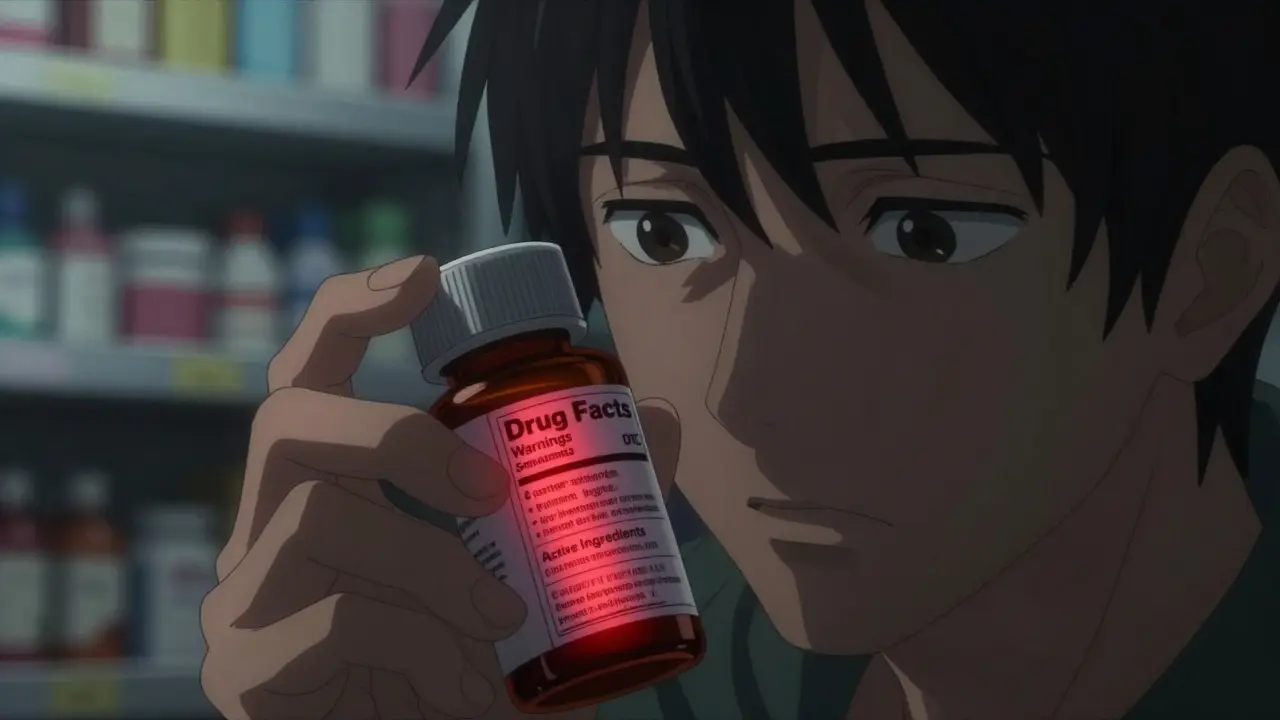
Every year, millions of people in the U.S. grab an OTC medicine off the shelf without reading the label. They see the brand name-Tylenol, Advil, DayQuil-and assume they know what’s inside. But that’s where things go wrong. You might take two pills because you feel worse, not realizing you’ve already taken acetaminophen in your cold medicine. Or you give your child a dose meant for adults because the bottle says "for pain and fever." These aren’t rare mistakes. They’re preventable-if you know how to read the OTC drug facts label.
What’s on the OTC Drug Facts Label?
The OTC drug facts label isn’t just a sticker. It’s a federally required, standardized format designed by the FDA to make medicine information clear and consistent. Since 2017, every single over-the-counter medication sold in the U.S. must use this exact layout. There are six core sections you need to know, and they always appear in this order:- Active Ingredients
- Purpose
- Uses
- Warnings
- Directions
- Inactive Ingredients
That’s it. No marketing fluff. No vague promises. Just facts. And if you learn how to read each part, you’ll avoid the most common-and dangerous-mistakes people make with OTC meds.
Active Ingredients: The Most Important Section
This is where you find the actual medicine. Not the brand name. Not the slogan. The chemical name. This is non-negotiable.Look for the active ingredient listed with its amount per dose. For example: "Acetaminophen 325 mg" or "Ibuprofen 200 mg". That’s the dose you’re getting in one pill, tablet, or teaspoon.
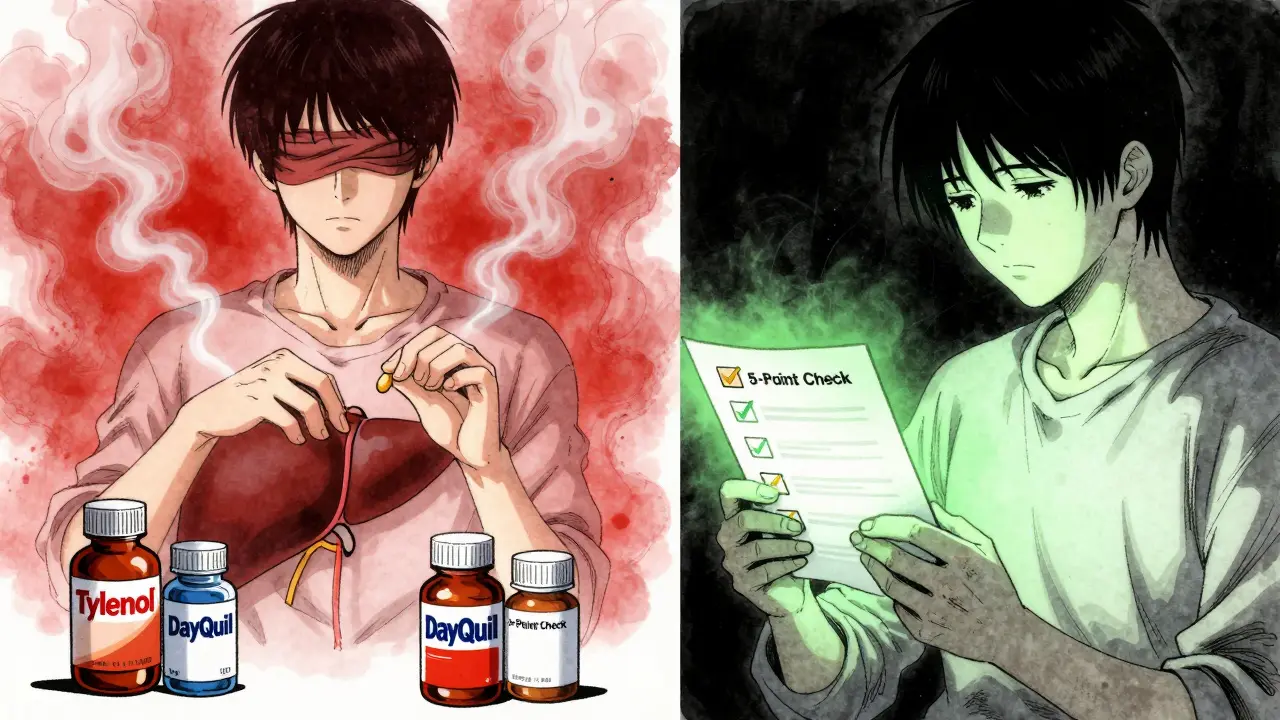
Why does this matter? Because the same active ingredient shows up in dozens of products. Acetaminophen is in Tylenol, Excedrin, NyQuil, Sudafed PE, and even some children’s cough syrups. If you take two products with acetaminophen, you’re doubling-or tripling-your dose. The maximum safe daily limit for adults is 4,000 mg. Go over that, and you risk severe liver damage. In fact, acetaminophen overdose is the leading cause of acute liver failure in the U.S.
Here’s a real example: You take one Extra Strength Tylenol (500 mg acetaminophen) for a headache. Later, you grab a bottle of DayQuil for your cold. It says it contains 325 mg acetaminophen per dose. If you take two doses of DayQuil, you’ve now had 1,150 mg of acetaminophen on top of the 500 mg from Tylenol. That’s 1,650 mg in just a few hours. You’re already over half the daily limit. And you haven’t even taken anything else.
Always check this section first. If you’re taking more than one OTC product, write down the active ingredients. If any are the same, don’t take them together.
Purpose: What the Ingredient Does
Right under the active ingredient, you’ll see its purpose. This tells you what the medicine is supposed to do. For example:- Pain reliever / fever reducer
- Cough suppressant
- Nasal decongestant
- Allergy antihistamine
This section helps you match the medicine to your symptom. If you have a stuffy nose, you might reach for a decongestant. But if you’re just trying to sleep, you might grab a "PM" version-which often contains diphenhydramine, a sleep aid. That’s not a decongestant. It’s an antihistamine that makes you drowsy. The "Purpose" section tells you exactly what you’re getting.
Don’t assume "cold medicine" means it treats everything. A product might only relieve a runny nose and sneezing-not your sore throat or cough. Always check the purpose before buying.
Uses: What It’s Actually Approved to Treat
This section lists the specific symptoms the FDA has approved the product to treat. It’s not a marketing list. It’s a legal one.For example: "Temporarily relieves these common cold and flu symptoms: sore throat, headache, body aches, fever, runny nose, sneezing, and itching of the nose or throat."
If your symptom isn’t listed here, the medicine isn’t meant for it. Taking it anyway won’t help-and might hurt. Don’t use a cold medicine for back pain if it doesn’t say "body aches" or "pain reliever." Don’t use an allergy pill for a headache unless it says "pain reliever" as an active ingredient.
This section is your safety net. If you’re unsure whether the medicine matches your symptom, skip it. Ask a pharmacist. Or better yet, don’t take anything at all until you’re certain.
Warnings: The Part People Skip (But Should Never Ignore)
This is the most critical section. It’s where the FDA tells you what could go wrong.Here’s what to look for:
- Do not use if... - This means you have a condition or allergy that makes this medicine dangerous. Example: "Do not use if you have ever had an allergic reaction to acetaminophen."
- Ask a doctor before use if... - You have a health condition like liver disease, high blood pressure, or are pregnant. Example: "Ask a doctor before use if you are taking a blood thinner like warfarin."
- Liver warning - If the product contains acetaminophen, this warning is mandatory. It says: "Severe liver damage may occur if you take more than 4,000 mg in 24 hours, take with other drugs containing acetaminophen, or consume 3 or more alcoholic drinks daily while using this product."
- Stomach bleeding warning - For NSAIDs like ibuprofen or naproxen: "Taking this product with other NSAIDs increases your risk of stomach bleeding."
- Children’s warnings - "Do not use in children under 12 years." Or "Use only as directed for children 2-11 years."
A 2023 FDA study found that 89% of pharmacists say the Warnings section prevents the most serious mistakes. Yet, 41% of consumers still miss key warnings because they skim too fast. Don’t be one of them. Read this section slowly. If anything says "do not use," put the bottle down.
Directions: How Much, How Often, How Long
This section tells you exactly how to take the medicine. No guessing. No "I’ll take one and see."Look for:
- Age or weight-based dosing (e.g., "Adults and children 12 years and older: 2 caplets every 4 to 6 hours")
- Maximum number of doses per day (e.g., "Do not take more than 12 caplets in 24 hours")
- Duration limit (e.g., "Do not use for more than 10 days unless directed by a doctor")
- How to measure (e.g., "Use the dosing cup provided. 1 teaspoon = 5 mL")
Here’s where people get tripped up:
- "Per 5 mL" doesn’t mean the whole bottle. A 4-ounce bottle of Children’s Motrin holds 118 mL-that’s 23 doses at 5 mL each. Don’t assume the whole bottle is one dose.
- "6 doses in 24 hours" doesn’t mean 6 pills if each dose is 2 pills. That’s 12 pills. That’s dangerous.
- "Extra strength" means more active ingredient. Extra Strength Tylenol has 500 mg per tablet. Regular has 325 mg. Don’t treat them the same.
- "PM" versions almost always contain diphenhydramine (38 mg per dose), a strong sleep aid. Don’t take it during the day unless you plan to nap.
Use the measuring tool that comes with the product. A kitchen teaspoon isn’t accurate. A dosing cup or oral syringe is. If you’re giving medicine to a child, always check the label for weight-based dosing. Age alone isn’t enough.
Inactive Ingredients: The Hidden Risk
These aren’t the medicine. They’re the fillers, dyes, preservatives, and flavorings. But they can still cause reactions.If you’re allergic to dyes, gluten, lactose, or sulfites, this section matters. For example:
- "Croscarmellose sodium, povidone, pregelatinized starch" - common fillers, usually safe
- "FD&C Red No. 40" - a dye that can trigger reactions in sensitive people
- "Lactose monohydrate" - can be a problem for those with lactose intolerance
- "Sodium benzoate" - a preservative that can cause allergic reactions in some
Most people don’t check this. But if you’ve ever had an unexplained rash, swelling, or stomach upset after taking a new OTC med, this is where you look. It’s also important for vegans or those avoiding animal-derived ingredients.
The 5-Point Check: A Simple System to Avoid Mistakes
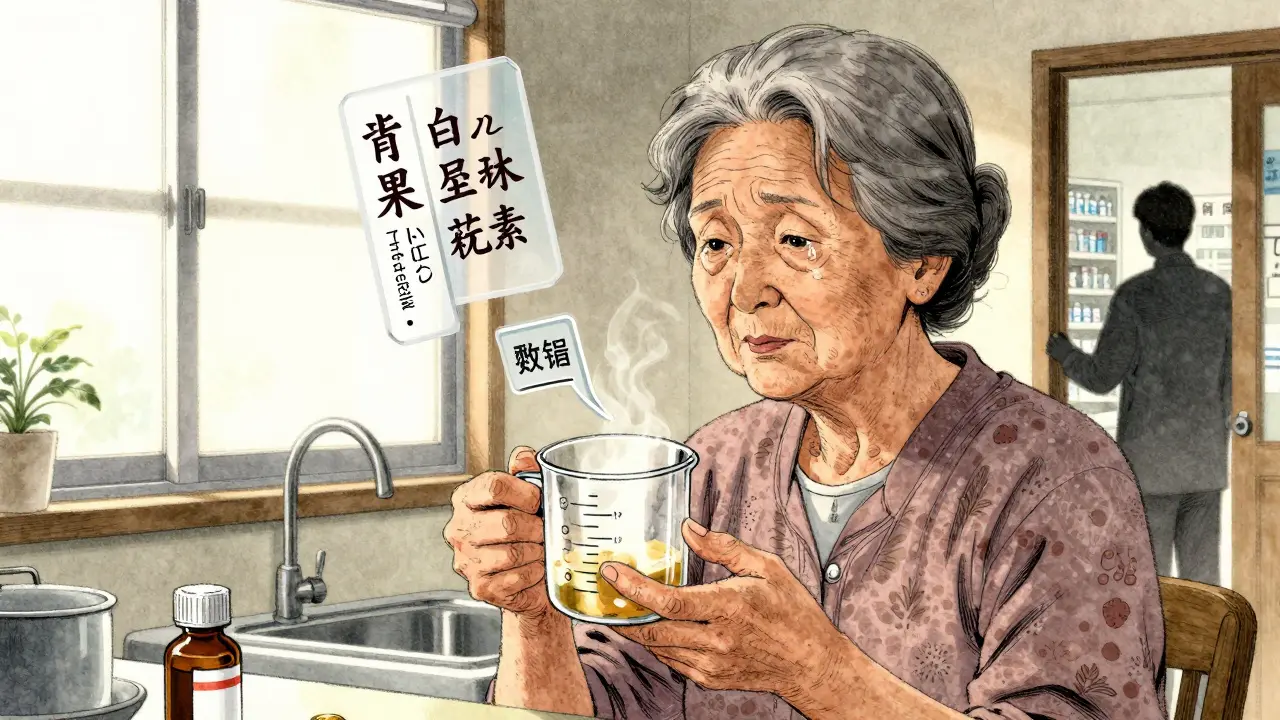
Pharmacists at CVS Health developed a quick method called the "5-Point Check" to help people read labels safely. It takes about 50 seconds-and it saves lives.- Identify active ingredients - What’s the medicine? Is it in anything else you’re taking?
- Verify uses - Does this match your symptom?
- Read all warnings - Do you have a condition that makes this dangerous?
- Check directions - Are you taking the right dose for your age and weight?
- Review inactive ingredients - Any allergens or ingredients you avoid?
A 2024 study found that people who used this method reduced medication errors by 68%. That’s not a small number. That’s life-changing.
What’s Changing in 2025?
The FDA isn’t done improving labels. Starting in late 2025, new rules will require:- Larger font size for active ingredient concentration
- Color-coded sections (red for warnings, green for directions)
- Simple icons for common risks (like a liver symbol for acetaminophen)
These changes are based on feedback from real users. Many people, especially older adults, struggle with tiny text. The goal is to make labels easier to read at a glance.
Even with these improvements, you still need to read. Technology won’t replace your attention. QR codes on bottles now link to video explanations, but they’re optional. Don’t rely on them. Read the label.
When in Doubt, Ask a Pharmacist
You don’t have to be a medical expert to use OTC medicine safely. But you do need to be careful.If you’re unsure about:
- Whether two medicines can be taken together
- What dose to give your child
- Why a warning applies to you
- Whether a symptom needs a doctor instead of a pill
Stop. Walk to the pharmacy. Ask the pharmacist. They’re trained for this. Walgreens reported a 40% increase in OTC consultations after launching a "Label Literacy" campaign in 2023. People were asking questions-and avoiding mistakes.
Pharmacists don’t judge. They’re there to help. And they’ve seen the consequences of skipping the label.
Final Thought: Your Health Is Worth 50 Seconds
You wouldn’t drive a car without checking the brakes. You wouldn’t eat food without reading the allergen label. So why take medicine without reading the facts?The OTC drug facts label is designed to protect you. But it only works if you use it. Take 50 seconds. Do the 5-Point Check. Write down the active ingredients. Ask if you’re unsure.
That’s how you take control of your health-not by guessing, but by knowing.
What’s the most dangerous mistake people make with OTC labels?
The most dangerous mistake is taking multiple products with the same active ingredient-especially acetaminophen. Many people don’t realize Tylenol, Advil Cold & Sinus, NyQuil, and even some cough syrups all contain acetaminophen. Taking two of these together can easily push you over the 4,000 mg daily limit, which can cause severe liver damage. This is the leading cause of accidental overdose with OTC medicines.
Can I trust "natural" or "herbal" OTC products?
Not necessarily. OTC drugs are regulated by the FDA and must prove safety and effectiveness. Herbal or "natural" products are often sold as dietary supplements, which are not held to the same standards. They don’t have to list active ingredients with exact dosages, and their labels don’t follow the Drug Facts format. That means you don’t know how much you’re getting, or if it interacts with your other meds. Always choose FDA-regulated OTC drugs over unregulated supplements unless your doctor recommends otherwise.
Why do some OTC labels say "for adults only"?
Because the dose, safety data, and potential side effects are based on adult physiology. Children’s bodies process medicine differently. A dose safe for an adult can be toxic for a child. Even "children’s" formulas have different strengths-never give a child an adult version unless a doctor says so. The label says "adults only" for a reason: it’s not a suggestion. It’s a safety rule.
Is it safe to take OTC medicine with alcohol?
It depends on the medicine. Many OTC drugs, especially those with acetaminophen or NSAIDs like ibuprofen, warn against alcohol use. Alcohol increases the risk of liver damage with acetaminophen and can cause stomach bleeding with NSAIDs. Even if the label doesn’t mention alcohol, it’s safest to avoid it. Many people don’t realize how quickly alcohol and medicine can interact-sometimes even with just one drink.
How do I know if I’m taking too much?
Track your doses. Write down what you take, when, and how much. If you’re taking more than one product, check the active ingredients. If you’re taking acetaminophen, don’t exceed 4,000 mg in 24 hours. If you’re taking ibuprofen, don’t exceed 1,200 mg in 24 hours unless directed by a doctor. Signs of overdose include nausea, vomiting, stomach pain, drowsiness, confusion, or yellowing of the skin or eyes. If you suspect an overdose, call Poison Control at 1-800-222-1222 immediately.
Do I need to read the label every time I buy the same medicine?
Yes. Manufacturers can change formulas, dosages, or warnings without changing the brand name. A bottle of "Tylenol" today might have a different strength or new warnings than the one you bought last year. Labels are updated regularly based on new safety data. Always check before each use-even if you’ve taken it a hundred times before.




Curtis Younker
January 27, 2026 at 03:26
Bro, I used to be the guy who grabbed Tylenol and called it a day-until my buddy ended up in the ER from mixing it with NyQuil. I didn’t even know they had the same stuff! Now I do the 5-Point Check every single time. It takes 50 seconds. Fifty. That’s less time than it takes to scroll through TikTok. Your liver will thank you. Seriously. Write it on your hand if you have to. I keep a sticky note on my medicine cabinet now. ‘ACTIVE INGREDIENTS FIRST.’ I’m not joking. This shit saves lives.
And don’t even get me started on ‘PM’ meds. I thought it was just a stronger version of the daytime stuff. Nope. It’s a sleep bomb with diphenhydramine. I took one at 3 PM once and crashed like I’d been hit by a truck. Woke up confused, drooling, and wondering why my dog was staring at me like I’d betrayed the family. Don’t be that guy.
Also, if you’re giving kids medicine, use the damn syringe. Not a kitchen spoon. I’ve seen moms eyeball it like it’s coffee. One teaspoon? Nah. That’s 5 mL. A regular spoon? More like 10. You’re doubling the dose. That’s not parenting. That’s Russian roulette with acetaminophen.
And yeah, labels change. I bought the same Advil last year and this year it added a new warning about stomach bleeding if you drink coffee. I didn’t even know coffee was in the ingredients. Turns out it’s not. But the warning’s still there. So I read it. Again. Because I’m not risking it. Your health isn’t a suggestion. It’s a contract with your future self. Honor it.
Pharmacists are the real MVPs. Walk in. Ask. They don’t judge. They’ve seen it all. I asked one last week if I could take ibuprofen with my fish oil. He said ‘sure, but space it out.’ I didn’t even know that was a thing. That’s why I go. Knowledge is power. And power means not ending up on a ventilator because you thought ‘it’s just a pill.’